

In conversation with Cody Leroy Wilson, playwright of the dynamic, deeply personal new play: Did My Grandfather Kill My Grandfather?
This summer, YNST was invited to attend the opening weekend of the Contemporary American Theater Festival (CATF). Held annually in Shepherdstown since 1991, the fest plays host to “the newest plays in America in the oldest town in West Virginia.”
Each year, thousands of patrons from across the globe flock to the small town for respite amongst the mountains and to see shows that are equal parts provocative and enthralling. Five shows by accomplished playwrights made their world premiere at the festival and continued to run on rotation for packed audiences throughout the next month.
We saw all five of the shows in the 2025 season, each drastically different from one another. “Happy Fall: A Queer Stunt Spectacular” by Lisa Sanaye Dring followed two stuntmen navigating the danger of their craft and exposing their love through dynamic live stunts, video, puppetry and more. “Kevin Kling: Unraveled” was a one-man show untangling the life of professional storyteller Kevin Kling with hilarious, heartwarming tales on redefining disability. “Side Effects May Include…” by Lisa Loomer was an autobiographical dramedy about one family’s ongoing battle with the medical system after their son gets drug-induced akathisia. “Magdalene” was a masterful two-hander by Mark St. Germain taking place eighteen years after the crucifixion as Peter reconnects with the banished Mary Magdalene.
All of these shows moved me, and as an actor myself, I was impressed with many of the performances, the professional sets and costumes, the dialogue and the direction. But perhaps the one that left the strongest impression on me was the fifth show, a one-man play written and performed by Cody Leroy Wilson. Notably, this was the only play written by a West Virginian and the only play about West Virginia — rarities for both CATF and in contemporary theater as a whole. In fact, his was the first play by a West Virginian playwright to premiere at the festival in its 34 year history in the state.
Vietnamese American, Cody was born and raised on a farm in a small unincorporated community called Plum Run. It didn’t take long for him to realize his origin story might look different from the other kids in the holler. Cody started questioning where he was really from and how he got to West Virginia. Examining his identity, race and family legacy led him to unearth his history: his grandfather, an American soldier, adopted his mother as a baby during the Vietnam War and took her back to America. As he continues to unpack the complexity of this dual heritage, Cody attempts to reconcile lost family history and the brutality of the war amidst his lived experience with his adopted family.
At the climax of the show, Cody dramatizes a real dream he had, switching perspectives between his American grandfather and his imagined Vietnamese grandfather on opposing sides of a jungle battlefield. The titular question that haunted Cody into penning this show comes to life on stage as he must ask: “Did My Grandfather Kill My Grandfather?”
In a time when the conversation around immigration in the United States is exceedingly fraught, I sat down with playwright Cody Leroy Wilson to talk about the impact of his time at CATF and on developing an on-stage look at his family’s immigration story.
Q&A with playwright Cody Leroy Wilson
AP: How would you describe your new play “Did My Grandfather Kill My Grandfather?” to those who didn’t get a chance to see it?
CLW: It’s my family’s immigration tale to America. It started because I was a young Vietnamese boy growing up in West Virginia, and I had a lot of unanswered questions. And so it became a collection of stories I would ask for from my uncle or my mom or my grandma. It became this little fantasy in my head for a long time, and then it turned into a narrative of my personal journey as a young boy all the way up until present day. The more and more personal it became, the more open and honest, the story fell into place. So for me, this is a single tale hoping to expand on the idea of how vast and varied a sea of Asian American immigration is.
AP: Was there any one moment in particular that made you think this needs to be on stage?
CLW: The idea for the play was actually sparked from a real dream that I had. I used to call it a nightmare. It was the conflict that you see represented in the show that brings up the hypothesis, did my grandfather kill my grandfather? I was in high school, but I always held on to that moment. I think that was my anchoring point for the whole thing, so I actually wrote the ending first. I wrote the dream sequence that led me to my ‘reason-I-wrote-the-play’ monologue at the end. I knew that the message was based on a real life experience I had. So I think that nightmare/dream that I had was the core climax, and I just spider webbed from there.
AP: How did you guys work that out during the rehearsal process?
CLW: So the rehearsal room was a great opportunity that CATF offered that most places wouldn’t. They offered development in Georgia, which allotted me space to do one-on-one with my director, Victor Maog. He was actually a guest artist when I was an acting student at West Virginia University, and was the first person to cast me, so it was a very full circle moment.
The original form of the play had this ‘TED talk’ energy. Here’s an experience, here’s what I learned. And in that time in Georgia, it allowed us to rewrite it to a more personal direction.
AP: But for a one-man show, even an hour must be a lot.
CLW: I was a very long-winded writer, but that was actually part of the development. We developed in New York as well, and I was allotted space to hear another actor say the words. I was allowed to be just a playwright. That’s what those two workshops helped me get better at, not so much as a performer, but the playwriting specifically.
AP: So much of this story is deeply personal, being both the actor and the playwright. What was the experience like letting other people into your world?
CLW: It was super vulnerable, because you get precious with a piece that’s so close to your heart.
The challenge that we found was that there were questions presented about the ending, specifically the part where I [talk directly to the audience]. There were suggestions to edit that, and I was very firm on that one. Up until that 50
point, I had made many cuts. I sacrificed stories and details about my family, I got rid of moments that I felt needed to be there.
As a playwright, it was hurtful sometimes, but I understood the goal was to make it as tight and compact and streamlined and digestible as possible. At first, I didn’t think we could achieve what I wanted as a playwright in less than 90 minutes, but we were able to do everything that a good play calls for in 65 minutes. I really believe that.
So the only time that it really got to me was the ending, and I knew that was a necessity to keep. [The play ends with Cody thanking the audience]. That is part of why the play was written — because these people, West Virginians, they’re the ones that brought me into the fold when my family had no one, so to trim any of that was difficult.
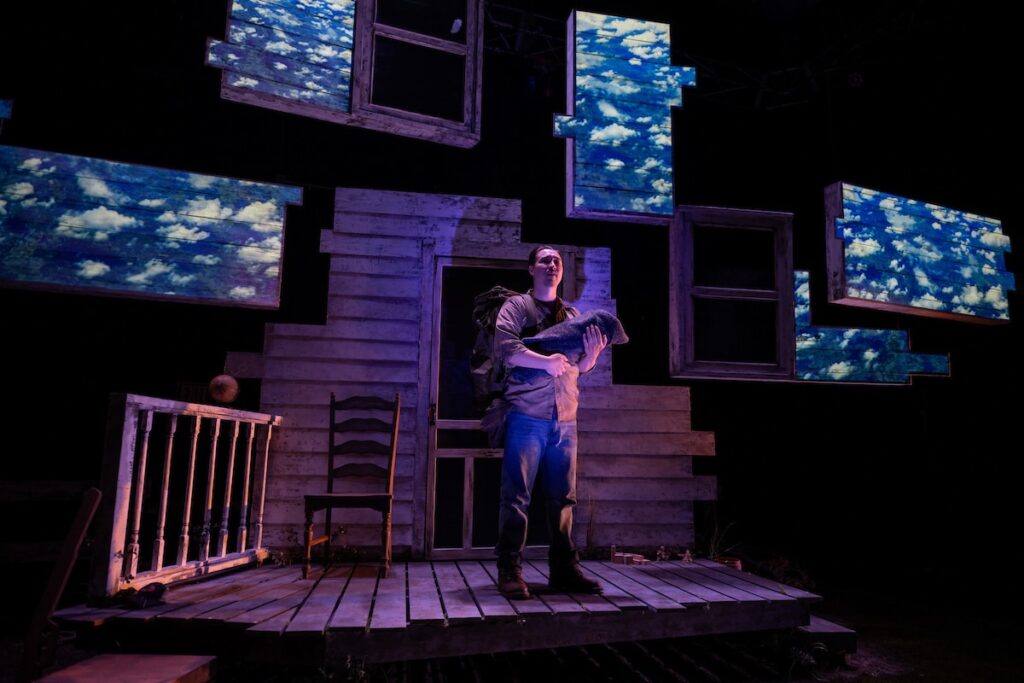
AP: I think there’s something special about taking a one-man show and then bringing in strong direction and creative choices. I really loved the projection elements and the set was great. My favorite moment in the whole piece was the way that you used the blanket in the end. It started folded to represent a baby then unfolded to be used in a funeral scene. Can you talk more about using these creative elements?
CLW: All of the props that were included in the show were a part of the playwriting experience. I wrote all of those elements in there specifically knowing that I was a one man army and that devices to help tell the story were going to be very helpful to theatrical audiences. I started building on those. When I finally got to the part of describing my mom’s age and when the Fall of Saigon happened, I knew that tangibility was going to help register the audience to feel my experience. I was holding my mom as the Fall of Saigon happened around me, and I think those devices were necessary.
Now, ironically, Kevin Kling, who was the world-renowned storyteller at CATF as well, said, “They call props crutches.” And I said, “Oh, that’s cool. I didn’t realize that Kevin.” He actually [jokingly] said, “A lot of my friends are going to give me shit for this.”
A lot of people were comparing us as storytellers, but in the world of theater I knew that tangible props were going to just be so impactful.
AP: How do you think growing up in West Virginia has sort of formed you as a writer, as a storyteller and as an artist?
CLW: Logistically, my accent. As a writer, my voice matches that of Appalachia. When I’m writing character dialogue, I know that it doesn’t sound like it’s from any other region but there. Reading my own work back to me has made me register that I am an Appalachian writer, but being a Vietnamese writer has this amazing comparison — the use of nature and spirituality and understanding. There’s a very strong parallel between poetry from both those regions.
So for me it’s a badge of honor now, and it’s given me more of a direction of how to write, who to write and why to write. I’m flattered that I can be such a really cool mix of heritage. I get to be a representation of two vastly different areas, and that, in itself, is like a rich gift.
I think the more I lean into it, the more I’m finding my flow as a performer, as a writer, as an artist, and it makes me support causes that match my own. Like I still work with a group that’s trying to better WVU. I’m now part of a Vietnamese group in New York City.
There’s such a pride that I have from growing up in West Virginia. I knew I wanted to physically represent it on stage. We used photos of my actual house as a kid growing up. And the stage manager was so great to put things that I requested, like horseshoes or a tire in the front yard. I wanted us to feel seen, not just heard, but seen. And I think that’s why I am so specific when I write, because West Virginia looks different than any other place out there. It does.
AP: Something that YNST is interested in is Appalachia as a place, but also as a culture and an identity. What’s unique about your story is that you’re talking about both your Vietnamese and Appalachian identities, and how you are sort of in a third space in between. You’re living outside of both of those places, and yet still feel so connected to both. Can you talk more about that?
CLW: I think you observe it more, the more time you spend away from West Virginia. You start realizing energy that you miss. People in the city are deprived of the outdoors. Oh, I was ingrained in it. People in the city are used to a fast pace of life — I hate it. I want it slow. I think the older I get, the more I realize West Virginia at its best is a feeling of peacefulness. It’s a home feeling. You go home and you can relax. I always felt that way, even as an Asian American.
I think when you spend time in West Virginia, even people who go to college there from out of state, they leave talking about West Virginia the rest of their lives, because there’s such a culturescape that you can’t describe. You know what it feels like the longer you’re away from it, and you get pulled towards it, back to it, even when you can’t get there.
I think artists continue to make art for the region because it’s such a root of inspiration. You can’t get inspired anywhere else the same way you get inspired in West Virginia. I think that’s why we keep doing it.
AP: So much of your story involves two people that you have never met: both of your maternal grandfathers. I’m curious about your research process to learn as much as you can about them despite never meeting.
CLW: For my adoptive grandfather it was through story. My uncle became a great source of information. He was 14 when my grandfather was in his final years of service and was old enough to remember all the way back to the start of the Vietnam War. We were able to find a lot of documents and evidence together, but a lot of it has been stories that I’ve picked up throughout the years just hearing about my grandfather. My grandmother always talked about him in present tense, even after his passing. He was always there and you felt it in the house. He helped build the house with his bare hands, so he was always there.
I think for my Asian grandfather, who I do not know, it became a journey of history. I had to give myself an intense history lesson. I had to find out the plausibilities of what a man might experience both in the North and South Vietnamese sides of the war. I had to understand the dynamic of the war, how it progressed and the timeline of events.
So I really just took an intense research dive, and because I never met him, all of it is fantasy. I took those parts that made me feel like a kid watching a superhero movie, but from the Asian perspective. Always being just out of reach of the actual answers was why I used factual details of the war to emphasize that I really had no answers.
AP: A month long festival is a long time to be doing a show almost every day. What was that experience like? How did the show change over time?
CLW: It was exhausting, but it was really magical. I loved doing it. A lot of people would ask me, ‘How do you do that so many times, having to be so emotional?’ But the more times I did the show, the sharper it got, the more precise my choices as a performer became. The more I was exposed to the experience of trauma on stage, the more I was able to get closer and more comfortable with the subject matter. So it healed me.
Every time I did the show, I learned something new. The wonderful thing about doing the show is that 99 people would show up to watch it, and then 100 people left together because I was that last one. Having an audience get what I was trying to do every single night is not a thing that happens often. So it built confidence in the show and in the choices that I was making. The experience of doing it so many times has fortified what I’ve always known, which is that this is a good story. People want to hear a story like this, and everybody has some perspective that connects to it.
AP: Did you have any special standout moments during that run?
CLW: There were so many. Some people even emailed me, which was very flattering. There was a Vietnamese gentleman, who said to me: “That was my story.” He said his mom was the daughter of an American soldier, was left in an orphanage, and [he didn’t] know anything about her. And he saw himself.
I had several people from West Virginia come up and tell me about how they wanted to adopt. And so they would tell me their adoption stories of Asian children from Korea and China, Vietnam, Thailand. People were sharing their families with me. There was one gentleman who [told me] his sister was on the last flight out of Saigon.
So these moments that you could only see in a movie, that I thought I was the only one experiencing, in West Virginia of all places, were finally being heard.
One gentleman said, “You sounded like you were from here. It was amazing. You sounded exactly like you’re from West Virginia.” I said, “Well, I am.” He saw us up there. Then he said: “I’ve never heard that on stage before. I’ve been coming to the festival for 30 years. That’s my favorite play I’ve ever seen.”
