

Inside the world of Appalachian paranormal investigation with professional ghost hunter Danny Strakal.
There’s a misconception about the paranormal that you need to empirically prove it, or that there is some black-and-white answer to the question of whether it’s “real” or not. Ghost hunter Danny Strakal aims to find answers for the things we can’t always explain.
Because his investigations run late into the night, Danny Strakal’s ghost hunting toolkit starts with an Alani Nu energy drink from Sheetz. But the formal tools of the trade include thermal imaging, a REM pod that picks up disturbances in the energetic field, a laser grid, a “spirit box,” and Danny’s favorite, the Mel meter, which has electromagnetic and REM pod capabilities. Plus, Danny carries a Polaroid camera, because as he explained, full-light spectrum images show up better on Polaroid film.
Danny, a native of Morgantown, WV, calls himself a “ghost hunter,” but what he does is closer to a combination of folkloric research and oral history, all onsite at places with complex stories.
Outside of his paranormal investigations, Danny runs Dark Hills Media, his own production company, so he’s highly skilled at photography and videography. “I’m very particular about footage,” he said. Danny leads “hunts” at various sites, including the Greene County Historical Society, where he invites laypeople to come with him to experience the paranormal. Mostly, though, his investigations are done privately with a group of friends, with select moments uploaded to his YouTube channel, Spirit Walk Paranormal.
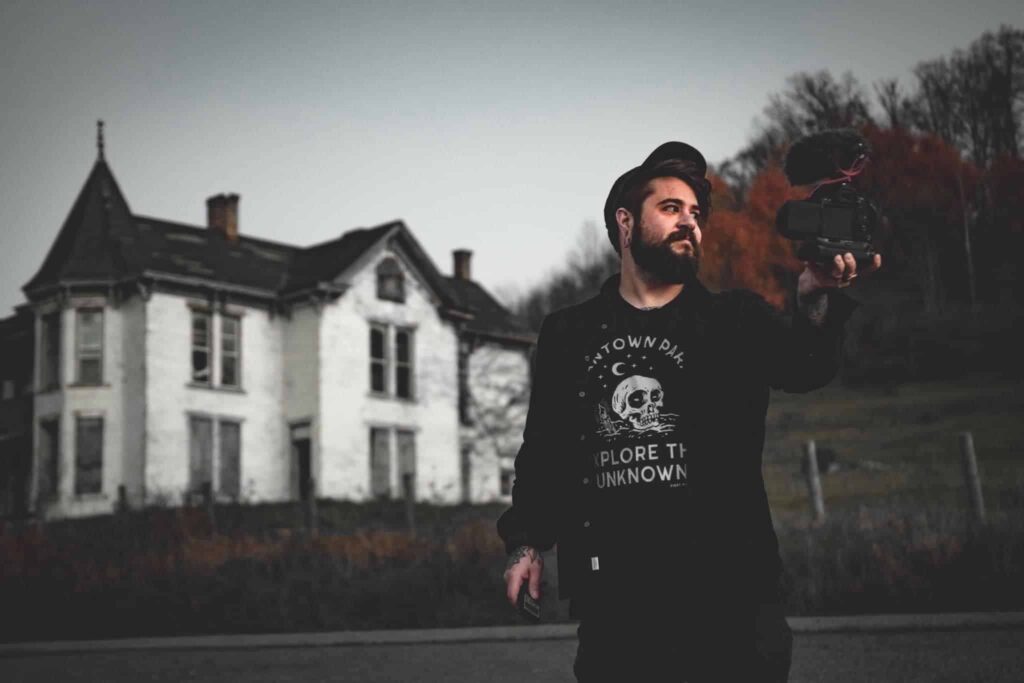
Danny’s upbringing in Appalachia allowed for an environment where his abilities were taken seriously — his parents didn’t wave away his childhood apparitions, rather, his mom told stories about it as a point of pride. “When I was a kid, my mom heard me talking to somebody in my room, which used to be my great-grandmother’s. She came down the hallway and asked who I was talking to and I said, ‘the lady in the chair.’ That was my great-grandmother’s chair,” Danny recalled.
Most people who’ve lost a loved one experience some form of their energy returning to the physical world after the fact. But Danny was attuned to that phenomenon after tragedy struck in his own life in Morgantown. “In 2010, my mom was killed in a house fire. I lived across the street. Later on, I felt like I needed a sign, so I went to the graveyard where she was buried and thought to myself, ‘Give me some sign you’re okay.’”
That sign appeared when he returned to his home. “When I got home, a book from the display shelf from my house that I never touch had perfectly fallen — it was The Book of Yahweh: The Holy Scriptures,” Danny said.
Before we had access to as much scientific information as we do now, for some communities, including Appalachian ones, there are still ways in which folklore is real. Sure, maybe there’s a psychological explanation for experiences like Danny’s with his mother, but psychology and mysticism aren’t so different — both look for ways to explain the unseen forces that shape human life.
The Appalachian region has a reputation for its residents being superstitious. But rather than veering into stereotypes about superstition as “backwards,” people like Danny take seriously the idea that people feel changes in energy that they can’t explain. Former industrial sites in southwestern Pennsylvania and West Virginia’s northern panhandle certainly have ghosts, if only in the form of memory. One wonders: Is Appalachia more haunted than other places, or are other places just better at hiding it?
Another consideration is that the paranormal can be a way to really internalize what happened at places of intense suffering. The Historical Society is a former alms house or county home, where the disabled and the poor were incarcerated, often for life, while their supervisor and his family lived in ordinary rooms upstairs, so a history of suffering and pain informs the house’s haunted status.
“The spirits here get nasty sometimes, just like humans do,” Greene County Historical Society Executive Director Matt Cumberledge explained. “It’s like having a house full of teenagers. If I come in late at night, they get annoyed.”
While you can read about the people that were incarcerated at the Historical Society on plaques or in paper materials, wandering around and trying to talk to the spirits in the halls they used to reside in forces you to engage with the emotional truth of each individual life spent locked up and abused by corrupt supervisors. Matt noted that certain supervisors held grudges against people in nearby Waynesburg and looked for reasons to send them to the county home: a woman walked too sensuously, a man looked too drunk, a teenager was too rowdy. Folklore and superstition serve as memorials to the past and warnings to the future, and places like the Greene County Historical Society hold profound ties to both.
Matt and Danny have come to intimately know the spirits at the Historical Society and their patterns. Matt claims at night he’s felt spirits tap on his shoulders, which tell him it’s time to leave. Throughout our time at the Historical Society, we heard bumps, crashes and even an inexplicable shrill sound. Danny speaks to the spirits (or “entities,” as he calls them) with a gentle, authoritative tone. “If anyone’s here, I have two new friends with me,” he called out into the seemingly empty room we stood in at one point. “I have some things you can touch, if you want to,” he added, gesturing to the Mel meter and the electromagnetic reader. Sure enough, small disturbances beeped in the machine. “We try to bring positivity, not provocations,” he said.
Later into the visit, Danny led us upstairs into a child’s bedroom. “I try to bring trigger objects that spirits will respond to,” he explained. “Playing cards. Cigarettes. For some reason, spirits love tobacco. All they really did back then was smoke and drink. But I’ll bring a toy ball or things like that, for this little boy, Tommy…”
“What about more modern objects, like an Xbox?” My friend Rachael, who was accompanying me, interjected.
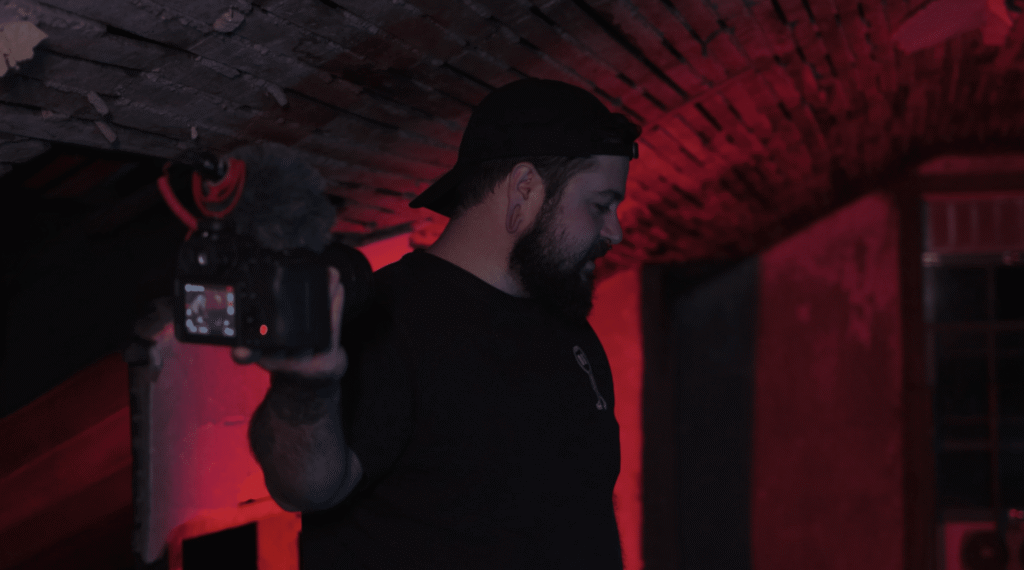
Before Danny could respond, his electromagnetic force detector began beeping rapidly.
“I guess he wants an Xbox,” Danny said as the three of us dissolved into laughter.
The detector beeped continually, in a way that Danny characterized as playful in the case of this spirit. Whether or not Tommy’s spirit really wanted an Xbox, Danny is not here to convince anyone that ghosts are or aren’t real. “We always try to debunk things and look for other explanations,” he said.
There are also paranormal sites and haunted locations he won’t visit. Recent murders are also off limits to him. And though he makes house calls frequently, a recent one in Mount Morris, PA, made him rethink that part of his work. “People always talk about evil things and demons, and most places I’ve been to there are no demons, just aggravated spirits. But this house had something evil,” he recalled.
The house was on a side of town formerly referred to as Whore’s Corner, and Danny believed it was a clinic for sex workers during the height of a local prostitution ring. The attic had a 16-inch-wide opening to a secret room with no windows, with a dumbwaiter down to the rest of the house. Doilies were nailed into the wooden walls, but there were no windows for them to cover. A discarded cigarette pack from 1911 marked that there had once been someone up there, but Danny found no historical records indicating who they were.
“Through the spirit box, we learned there was a woman named Anna there who was planning to expose the prostitution ring, and that she and her children were killed in the yard.” The family that lived in the home had called Danny in distress because of an overall feeling of bad energy and the children feeling unsafe. While he did feel like he made headway on getting them answers, it felt like looking at something he wasn’t supposed to see. He plans to write a book about the experience, but for the meantime, he’s paused doing residential calls.
The tools Danny uses do provide some form of proof to answer the looming questions of whether ghosts are “real” or not. However, the value of a ghost hunt isn’t just seeing or experiencing ghosts. Walking the halls of the alms house with Danny required extreme focus and attention to the slightest noise or disturbance. When Danny asked “Can you knock if you’re there?” to unseen forces in the halls and I heard a crash, I felt it in my body.
Attention is something in extremely short supply in modern life, constantly commodified and fragmented to the point where most of us can barely do a chore or watch a movie without being distracted by something else. Trying to attune yourself to the paranormal requires real focus, putting your phone down and listening. Is it sad and a little macabre that unprovable paranormal experiences feel more “real” and grounded than contemporary daily life? Maybe. But long before humanity knew empirical data, we relied on our senses and unseen intuitive forces to understand the world around us. And ghosts aren’t so different from the living, after all, as Danny mused: “Most of the time, spirits just want to be noticed.”
