

The singer-songwriter on finding healing through music after Hurricane Helene and putting down new roots in Los Angeles.
When singer-songwriter Indigo De Souza (she/they) bought a plot of land in Marshall, NC, she didn’t say it was a place to live. “I wanted a place I could die,” she told me. “Somewhere that could be my final resting place.” With songs like “Kill Me” and “How I Get Myself Killed,” listeners know Indigo for her honesty about mortality. But her plot of land in Marshall became a space for healing and community when Hurricane Helene devastated the western North Carolina mountains where she spent her childhood.
When the hurricane raged over Asheville, Marshall and the surrounding area, Indigo was on tour in New York, watching video footage of the top of the house that she lived in with her friends floating away in the flood. “I was living with two of my best friends in an old church building. It was a very dreamy living situation; we’d been there for four years, and we’d made it so cozy. We had a beautiful way of existing together. It was just so wild to have that and for it to be gone so quickly,” they remembered.
The land she bought in Marshall as “a place to die” turned out to be a place of safety and thriving during the flood, because it was on higher ground and had outdoor cooking facilities. She was forced to cancel several events she could no longer do because of lost musical equipment and postpone part of her tour.
“I just remember it slowly sinking in, grasping the idea of what was going on. I remember it hitting me that, well, obviously my house was ruined,” they said.
It was an emotional time: camping, gathering supplies and furnishing a tiny house she had bought off Facebook Marketplace and had hauled onto the land. Friends and family who had no power showed up out of the blue. She lit candles, played board games and cooked meals with the people close to her. “People would just show up and hope that you were there,” she remembered.
But the loss was still palpable. “The hardest things to lose were my sentimental items, my blanket that I had as a baby, or a box of family photos. Everything else I found some way to just let go of.” The entire experience was a reckoning with just how fragile the infrastructure around her life was, and how quickly the things that seemed permanent could just disappear.
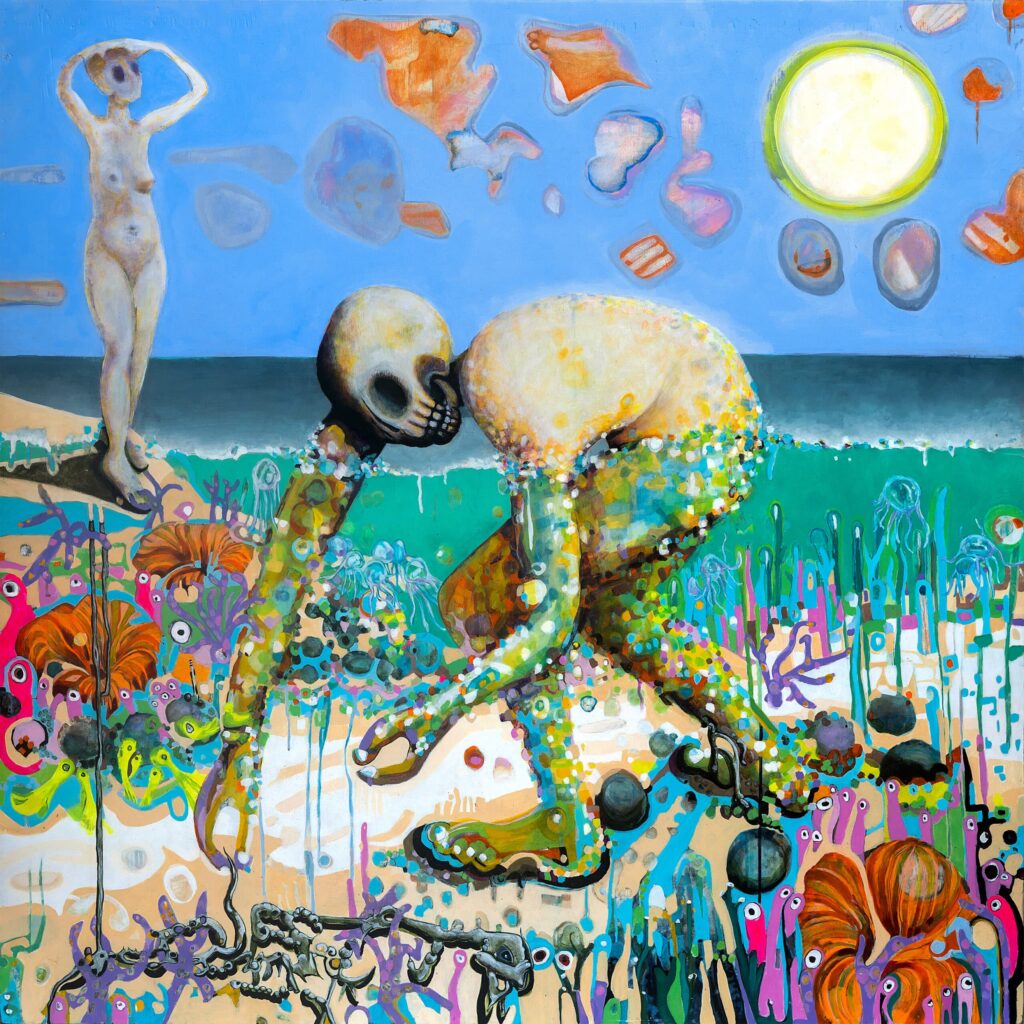
Cover art for Indigo De Souza’s album
Precipice painted by her mother, Kimberly
Oberhammer (2025)
In an Instagram caption right after the flood, Indigo wrote, “Please hear me when I say—something, in some way, will touch your life eventually— no matter how invincible you feel. Pain, loss, hardship. It will come to you. And when it does,,, the stupid videos and dusty fragments of paraded attentions that used to hold your gaze so close will feel like mere glimmers in a completely insane moving picture.” At a time when so much of our attention is sucked up by pointless digital miasmas, the sharp relief of tragedy can jolt you out of the numbness.
Indigo’s music has always dealt with loss, though. The title track off her third album, All of This Will End, shows a solemn but peaceful acceptance of things being temporary. In it, she wrote, “Inside my cage I watch the clouds / Getting angry, turning dark and raining down / I let my fingers run, I want to turn my brain off / Want to turn my shame to dust / Nobody hears me, now I’m talking to myself / I’m talking to God or something / I don’t want anything to do with magic.” The song sees her struggling with how to make meaning out of something senseless, finally just throwing out, “Who gives a fuck / All of this will end.” It might be the easy route to think that Indigo has made meaning out of the tragedy of the hurricane, wrapping it up in a neat bow where suffering leads to absolution. But the Asheville region still feels the effects of the flood, and though the communities are beginning to rebuild, the disaster has left a scar.
At the time of the flood, Indigo had just finished her fourth album, Precipice — which felt discordant with the emotions she was experiencing. Precipice is poppier than her prior work, which sometimes evokes a gentler, more self-aware Courtney Love, or a more guitar-heavy, Appalachian-infused Aimee Mann. Her music is highly confessional, and that hasn’t changed — it just has a synthier, sparklier beat behind it. “When I was listening to the radio, I remember at one point thinking that it would be cool to write pop songs with more meaningful lyrics,” they said. The result was Precipice.
After signing with Loma Vista Records, she connected with producer Elliott Kozel, who invited her to his studio in Los Angeles. “He was really grumpy and hungover,” Indigo said. “But we just clicked right away and started writing together.” Elliott worked out of a warehouse he called “Pee Jar Studios” because there was no bathroom — you had to either walk six floors up, or pee in a jar. (Indigo clarified that Elliott now has a new studio, which has not one, but two bathrooms on the same floor, and no jar.)
“Heartthrob,” the lead single from Precipice, is closer to what people recognize from Indigo, a loud-and-fast, bass and guitar-led track with a music video set in a bouncy castle, a call-back to a moment in the lyrics. Indigo described the song on Live in Limbo as “harnessing anger and turning it into something powerful and embodied.” There’s something pure and earnest about the song, like the feeling of watching a sunset on an early summer night and knowing the sky won’t ever look exactly the same as it does just then. One YouTube comment on the music video summed up “Heartthrob’s” vibe as “life’s messy, but it’s ours.” The song is full of short, rhyming couplets with joyful wordplay. One favorite is “I, I wanna save them / Get back to my celium.” There’s no such word as “celium,” but she’s referencing “mycelium” as in fungi spores in the dirt as a way to express wanting to get back to her roots.
Many of Indigo’s roots come from her mom, Kimberly Oberhammer, a lifelong entrepreneur who opened a pizza shop and a bakery during Indigo’s childhood. Her mom now creates all of her album artwork, and her first album is fittingly titled I Love My Mom.
Though she was born in Connecticut, Indigo moved to a log cabin in Burnsville, NC, then the small town of Spruce Pine. “When I was a kid, I was really different from the people around me,” Indigo remembered. She was one of the few people of color in Spruce Pine — her father, who was mostly absent in her life, is a Brazilian bossa nova guitarist. She started playing guitar herself at only nine years old, at pick’n’jam sessions in the woods or outside local restaurants.
“My mom was a wild artist lady, and it was really clear that our family was different,” Indigo remembered. When they work alongside their mom now, they give her a basic concept and let her build on it. Each album features figurative characters that Indigo feels have grown older and changed along with her.
“I give her an idea of the scene that I want painted and the kind of energy that I want from the characters, and it seems like she just kind of runs wild with it. This time [for Precipice], I explained to her that I wanted something to do with water, some kind of cliff or edge where someone is standing,” Indigo said. “I didn’t even expect it to look the way that it looks. It’s very pop and bright and the colors are very neon, which I think makes a lot of sense for the album.”
At 16, Indigo moved to Asheville with their older sister, where they learned about artists like Bill Callahan, Sun Kil Moon and Sparkle Horse. The move to Asheville came after her grandfather, who had dementia, came to live with her and her mother, a period she described as “too intense” for her.
But music and the community around it became a way for her to find a new start. Life in Asheville meant honing her craft through meeting other young musicians. She developed her unique songwriting voice through being around a more diverse group of people and seeing that people her age played in their own bands. “I learned about a whole world of artists for sad people,” she joked.
Pop music stayed a part of her life, too, even as she became more ingrained in Asheville’s indie music scene. “The first car I ever had was this old beater, and the only thing that would play on it was pop radio. I noticed earworms like ‘The Middle’ by Zedd and Maren Morris, where the hook would just stick in your head.”
Part of what makes Indigo’s music so memorable is that it has that poetic, confessional quality in the lyrics paired with a clear love of catchy, tight composition. Nothing they put out feels limp or lifeless. There’s always an upbeatness, even in her darkest of tracks. “Pretty Pictures” off of her sophomore album, Any Shape You Take, perfectly captures the bittersweet denouement of a dysfunctional relationship, the push-pull of the relationship coming through in the gentle discordance of the rhythm guitar and Indigo’s emotive vocals.


Though her adolescence in Asheville was over a decade ago, Indigo still credits that time as formative. “When I listen to older songs of mine, they’re really angsty. I’m still really angsty. I just express myself a little bit differently,” they said. “I’ve really never been able to write from the perspective of another person. It’s all my reality. I usually write about things that I’m processing, fears that I have about the future. It’s like a journal.”
Precipice is still that, but the focus is on being honest with herself. “I’ve been thinking of general mantras, growing up and being in community with other people, learning about relationships, learning to express yourself and being in community with other people,” they explained. “A few of the songs I put on the album are very much about encouraging your truest self, following your heart and saying no when you want to say no.”
When Indigo finished Precipice and lost her house, she felt moved to create something new. So, in the span of a few months, she completed yet another new album. She mentioned that when she showed it to her label, they noted it was really different from Precipice. But how could it not be? “I was in this bright, pop era and then got hit with this very real intensity from the flood. [The new album] came out very heavy. It feels like it’s going back to my guitar roots,” she expressed.
Being at home in North Carolina, however, meant Indigo had fewer resources to record with. After a few cross-country trips, she ended up turning a couple-days stay in Los Angeles into a permanent one.
She had been “living in the middle of a huge piece of land hearing birds and bugs, seeing the stars, not seeing anyone else around.” But Los Angeles is very different from a plot of land in the mountains. The move from one disaster also put her close to another: the 2025 Los Angeles wildfires. Though she wasn’t living in an affected area, she recalled going into “prep mode” and “definitely overreacting,” telling Elliott that the two of them needed to be ready to go at any moment.
Her new-new album from the post-flood processing is in production for release in 2026, but for now, she’s just working on nesting in her new home in Southern California and allowing herself some space to breathe after a turbulent year, thrifting and buying more furniture on Facebook Marketplace. She called it being “in a place to just gain life experience.”
But she misses the mountains and the quiet, and spending time with her family. Her connection to Appalachia manifests as a connection to nature, walking near creeks and foraging for plants with the creative community she surrounded herself with, many of whom are farmers, herbalists, foragers and potters. “I’ve always had this preciousness around community, feeling really deep about the people that I love, and the flood only made me realize that more,” she said.
Though she’s on the other side of the country, she knows her community will always be there for her. “It doesn’t matter where I go or how long I stay in LA,” Indigo said. “I really deeply care about the mountains, and I’m proud to be from there.”
