

Molded by the realities of rural life and raised by “story-tellers, bullshitters and people that love to sit around and talk,” musicians Montana Hobbs and Linda Jean Stokley are part of a proud lineage of Kentucky women: tough, down-to-earth, unshakably honest. With their May 2025 releases, “Darlin’ You Don’t Know That’s Wrong” and “The Space Girl’s Song,” both self-produced for their new independent record label, Soli Doli Records, they’re stepping forward not just as musicians, but as defining voices of a new Appalachia.
For over a decade, The Local Honeys have been shaking up the folk and roots scenes — breaking rules, blending traditions and taking inspiration from their own lived experiences. Drawing on old-time music, bluegrass, rock‘n’roll, psychedelic rock, Americana and singer-songwriter sensibilities, the pair craft songs that speak directly to a generation, reckoning with both the beauty and the burden of their homeland. They’ve played as a duo, trio and with a band. Their most recent shows highlight the duo, with accompaniment from their band: Chris Justice on bass, Max Nolte on drums and percussion and Don Rogers, who plays fiddle and guitar.
Their most streamed song, “Cigarette Trees,” is based off the Martin County Sludge Spill, which was an accident that occurred after midnight on October 11, 2000, when a coal sludge impoundment in Martin County, KY, broke through an underground mine below, propelling 306 million gallons of sludge down two tributaries of the Tug Fork River. The song details how damaging the coal industry has been to the land, animals and humans that inhabit the area with punchy chords and hard-hitting yet funny lyrics.
My favorite part of “Cigarette Trees” is the third verse. It describes the lengthy process of degradation on a mountaintop and everything that inhabits it by a coal company. However, since they can’t claim, buy or ruin the sky, critics are metaphorically able to “flip them the bird” in defiance.
“Strip off her top
Knock her to her knees
Disgrace that big ole mountain
With your broad-form deed
Kill animal and human
Every plant and herb
You can’t help but leave thе sky
So we can still flip you the bird.”
The Local Honeys speak directly to a generation who knows what it means to grow up between hollers and highways, a generation who’s roller-skated through beer stores and walked orchards at dawn. The energy they bring on and off the stage can be felt listening to them talk or sing, and if you don’t know them well enough, you might even mistake them for sisters. Both girls agreed that the way they were raised was eerily similar — with no sisters, but a family full of
hard-working individuals: railroad workers, automotive factory workers, land workers and farmers.
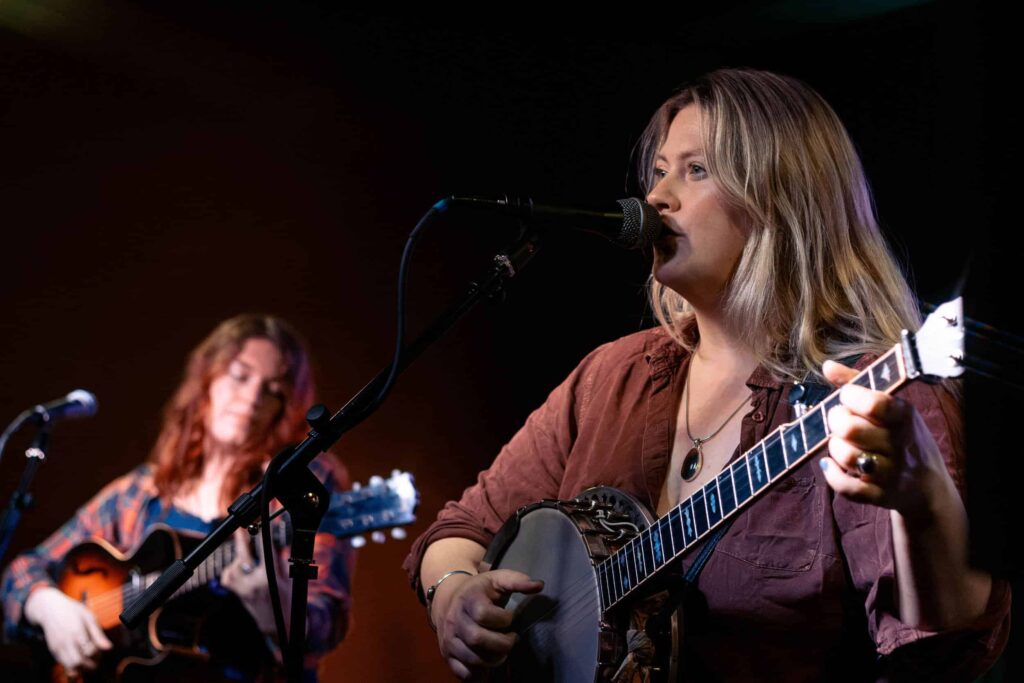
The duo met at Morehead State University in Kentucky, where they both started in Fall 2009 but didn’t connect until joining the old-time music ensemble a couple years later. Montana had initially majored in pre-veterinary studies but switched gears, taking general education classes and banjo lessons while Linda Jean was learning to fiddle. Their friendship and musical bond grew from those early jam sessions, despite both being relatively new to their instruments.
“We spent a long time learning music from living and late fiddlers, to banjo players, songsters and songwriters from our area. I’d been a musician my whole life, but I didn’t discover traditional music and fall in love with the home music of Kentucky until I was in college,” Linda Jean said.
Their parallel upbringings (rural, rooted in family and land, with unlikely beginnings in music) form the emotional and cultural backbone of their partnership. Now, both women write, sing and play a variety of instruments.
“At the time, I didn’t know that she was new to the fiddle. I was just like, ‘Oh, she’s so good,’ you know. I couldn’t play at all, really,” Montana recalled. “Then at some point, she was like, ‘Do you want to come over and hang out and play some music?’ And nobody had ever asked me to do that in my life, because I was not a musician at all. I was an athlete in high school — you can’t be this tall in Eastern Kentucky and not play basketball,” she joked.
Montana reflected on growing up near the Red River Gorge and Natural Bridge State Park, a region known globally for rock climbing and beautiful scenery. Though her small hometown of Beattyville, KY (population of 1,178) resists being associated with the Gorge, she embraces the connection. She recalled childhood memories like rollerblading in her family’s store — an old post office turned beer store, nestled on the county line of a dry county — where she had her first experience with a language barrier.
“I remember distinctly, these two young guys from Japan were there to buy beer, and they hardly spoke any English,” Montana said. “They were kind of having a hard time, making the exchange and stuff like that. And I was drinking an Ale-8-One (a ginger and citrus-flavored soft drink originating in Kentucky). They used to have them in long neck bottles, and they were thick glass. I was maybe five or six and I was just walking around with this big green bottle. They thought, and I could hear it in their voices talking in Japanese to one another, that they’d stumbled in on this little hillbilly kid drinking a beer in the beer store.”
Her family sold the beer store around the time she was in sixth or seventh grade, but she still reminisces on her years in the store, roller skating around and opening the door for the same patrons day in and day out.
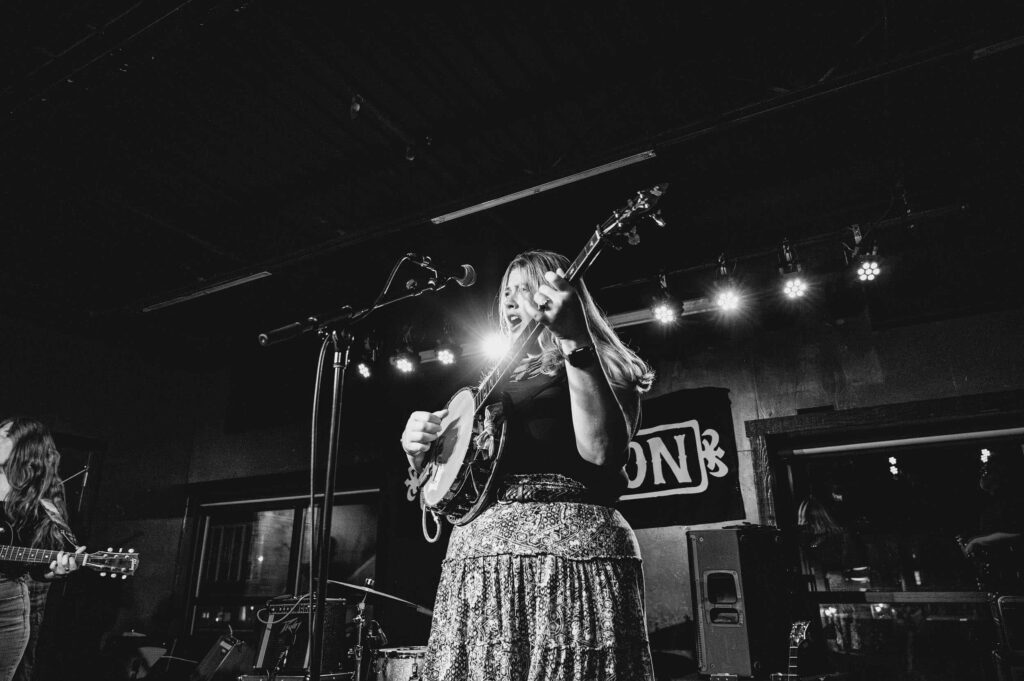
Her musical partner Linda Jean Stokley grew up in Woodford County, KY, home to some of the top bourbon distilleries, vineyards and horse farms, surrounded by lush farmland, rolling hills and historic rock walls. Her roots trace back to Switzerland, where her ancestors were foresters.
They brought arboriculture and logging traditions to Kentucky. That legacy continued through her family’s orchard and farming life, with her father raising tobacco and cattle, and her grandfather and great-uncle running orchards featuring heirloom fruit varieties.
Though she never expected to become a musician — especially not in her hometown — her connection to the land she grew up on remained central. She spent most of her childhood outdoors on the farm and in a family-run market with concrete floors, where she, like Montana, rollerbladed after school.
Today, her ties to home are still just as strong. She finds peace walking the land her grandfather passed down, which is still family-owned. Being home means being in nature: watching deer and turkeys, smelling spring onions and reconnecting with the land that raised her.
She said she gets that feeling on tour — either admiring similar, lush, green, rolling hills and rock walls in Europe or driving non-stop back from Colorado with only a walk through her family’s land on her mind.
The Local Honeys work hard and have lived on the road for months at a time. Montana and Linda Jean said they obviously work well together, but know how to work through things when they don’t go well.
“It’s just like any sort of relationship; you have to deeply understand somebody and figure out what someone needs. I mean, this is our longest standing relationship, other than our families. Just like you would have a partner, you have to just kind of check in every now and then and be like, ‘Hey, you’re not being very nice to me,’ or ‘You’re not pulling your weight.’ You know you have to hold one another accountable. But then you also get to celebrate together too, and for the most part, we’re usually on the same wavelength,” Linda Jean said.
Historically, Linda Jean has served as the idea machine and Montana as the “Yes Man,” Linda Jean said. Linda Jean brings new ideas to the table and Montana helps bring them to fruition.
“I don’t really have too much of a drive to do anything music related that’s not with Montana. For the most part, we are very good at resolving our conflicts with one another, if we’re just not on the same page. That’s just gonna happen, it’s the most human thing,” Linda Jean said.
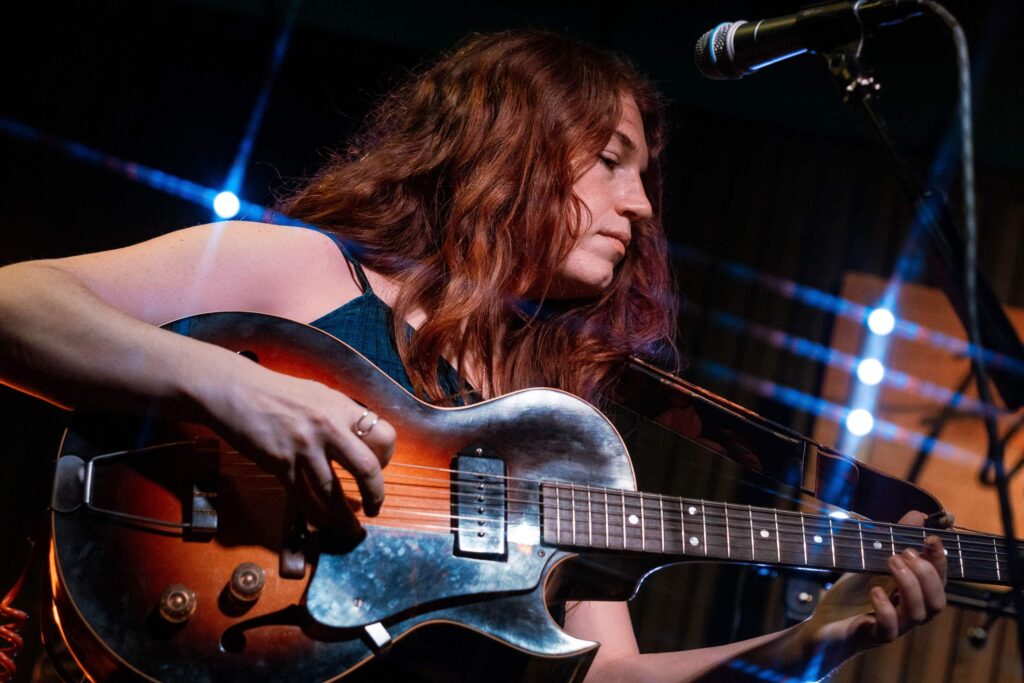
The duo discussed some of their influences — The Chicks and John Prine, among others — but said they’ve worked to develop their sound into something that is completely their own. Montana said one of her struggles as a beginner songwriter was writing songs based on stories, which would always end up being eight minutes long. One of the first songs she wrote that they loved (and named their first album after) is “Little Girls Acting Like Men.”
“I wrote it about a friend who was very feminine, but very tough, and one of my best friends. She would have all these relationships and stuff like that, but she was very adamant: ‘Even if he breaks up with me, it won’t be this big dramatic thing, and he’s never going to see me cry.’ I was
like that too. I was just like, ‘Oh, don’t let anybody ever see you cry.’ Then, pretty much after I wrote it, the tears started rolling,” Montana said.
“Well they ball up their fists,
And they drink like a fish,
And they look for a fight every night.
When the going gets tough, these girls pack up,
Just like all the men in their lives.
These little girls actin’ like men,
They swear you’ll never see them cry again,
They run with the boys,
With a womanly poise,
And then they go and carry on like grown men,” The second verse and chorus of “Little Girls Actin’ Like Men.”
Before the release they discussed what to title the album.
“I was like, obviously, ‘Little girls acting like men.’ Number one, that’s hilarious, and it is very much us,” Linda Jean said. “Number two, it’s relatable. She wrote this song about one of her best friends, who’s tough but is still this fragile girl inside. I was like, ‘Man, that’s also you and that’s also me.’”
Another powerful song from the duo is “Dead Horses.” It examines the cycle of life while describing the deaths of two beloved horses. The song opens with the death of a small, buckskin pony, being mourned by her mother and Linda Jean. The imagery in this verse is vivid and deeply affecting—so tangible it almost makes your stomach ache. To me, the song serves as a reflection on life itself—not just a horse’s life, but the fragility and beauty of all living things. It’s a quiet, powerful reminder to be grateful for what we have until we don’t have it anymore.
The first verse of “Dead Horses:”
“The saddest thing I think
That I ever saw
Was a little buckskin pony
Mourning from her stall
The mama lay beside the fence
Under a tarp out in the rain
Peeking from the plastic
Was her honey-colored mane
I sat down on a water trough
Wrung my hands and cried,
“Suppose we’re all just animals
With slightly different hides,”
Their challenges in the music business stem from being independent artists in a saturated industry. “Making your music accessible online is easier than it ever has been in the history of people being able to record and release their own music, and we are living in a time where there is an absolute sea of men with guitars,” Linda Jean said. “There’s just, like, such an influx of that because of incredible songwriters from our region that have made it to national and international stardom that everyone is so inspired.”
They added that some festival line-ups don’t tend to cater to traditional music or necessarily make certain that there are women being featured. Being women in a male-centered industry can be intimidating, but they’ve never struggled too much with it.
“I think the bigger challenge is maybe being like independent artists, not just a woman, because we carry femininity with us. We show up to the table, and here’s who we are. We carry ourselves in a way to where it’s like, you either like it or you don’t; you want to work with us or you don’t,” Montana said.
Linda Jean emphasized that despite those challenges, they stay focused on their own artistic path, valuing authenticity over industry trends. She’s proud of their unique sound and doesn’t see competition — especially among other women — as a problem, since so many current female artists have carved out distinct voices.
“I didn’t get into the music business to be treated fairly by any means. I think that you just have to stay in your lane and just be your own artist and try to continue to search for your own voice. And I think that’s what just keeps moving us forward. I don’t know anybody that sounds like us and I’m really proud of that,” Linda Jean said.
Still, they remain grounded in their purpose, creating meaningful songs and honoring tradition, while also carving out their own space in a crowded musical world.
But it’s their storytelling — the raw kind passed down by generations of Kentucky women — that sets them apart. Their songs are not just about place; they are of it.
To learn more, check out The Local Honeys on Spotify, Apple Music, their website or Instagram.
