
Appalachian influencer Alaina Wood is clearing the air on climate science and reshaping how people talk & feel about climate change online.
If you scroll long enough through the swirl of climate headlines, disaster footage and existential dread, you’ll eventually find a breath of fresh air: a woman looking straight into the camera and saying, calmly: “Here’s some good climate news.”
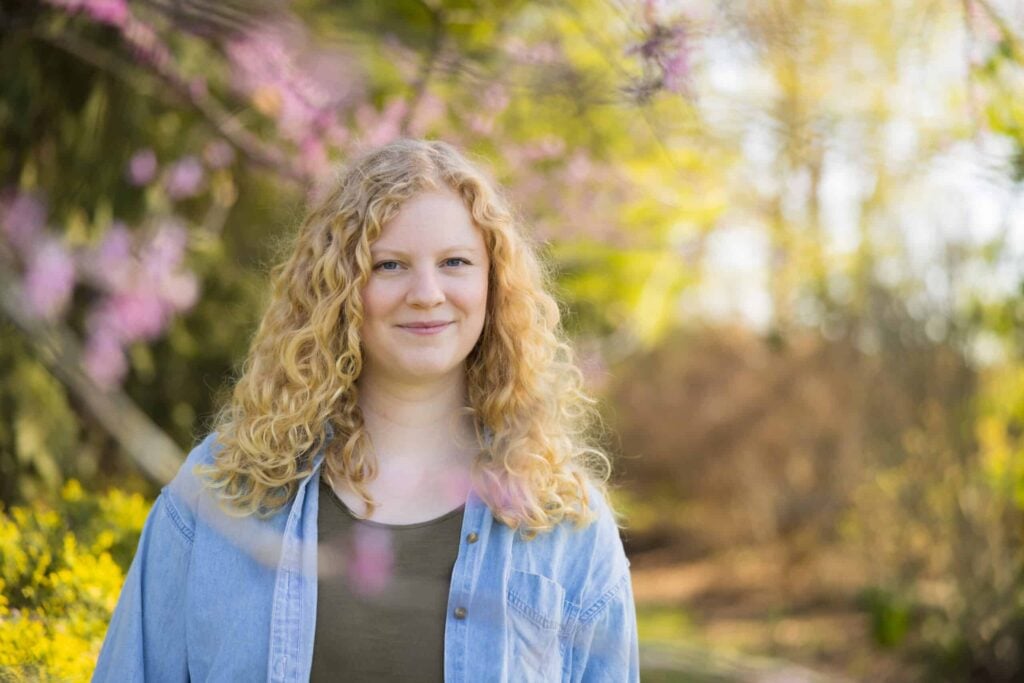
That woman is Alaina Wood, a sustainability scientist and climate communicator from east Tennessee, better known online as the “Garbage Queen.” Her videos cut through the flood of misinformation and climate doom that dominates social feeds, offering evidence-based perspective and stubborn optimism.
Long before Alaina shared her knowledge with the world, her fascination for sustainability was shaped by her civil engineering father who taught her about stormwater, pollutants, composting and what it means to care for the environment.
“Every time we drove to visit my great-grandparents in West Virginia, I’d pass coal mines, strip mines, quarries — all this environmental degradation. I remember looking out the window thinking,‘This isn’t cool,’ and my dad would say, ‘Yeah, it’s not.’”
Alaina distinctly remembers learning about climate change as an early teenager and was quickly drawn to the idea of working in the environmental sphere. When she found the sustainability program at the University of Tennessee, she knew what her future looked like.
“This is it. I get to do solutions instead of just issues.”
Alaina worked across the waste industry — recycling centers, landfill design, environmental compliance, rural planning — experiences that revealed the importance of infrastructure and the consequences of neglect. Those years made her very familiar with the reality of environmental work in rural areas. It also gave her the nickname that later became her online brand.
Rise of the Garbage Queen
It was early-pandemic TikTok that pushed her toward climate communication as a career. At first, TikTok was just a way to pass the time after her job’s government funding was cut, her roommate moved out and the world seemingly shut down.
“TikTok was going to be my friend during the lockdown.”
But the more she scrolled, the more she saw environmental misinformation go unchecked. She started posting videos because she was tired of watching these false claims spread.
Her early content was a blend of sustainable-living tips, climate science explainers and policy breakdowns. There was no real strategy behind it, but Alaina’s videos soon began to pick up traction. Her straightforward tone, shaped through years of navigating climate denial in her own community, resonated with viewers who wanted the facts.
Her following didn’t grow only because she filled a knowledge gap. TikTok was drowning in climate doom, and viewers were overwhelmed and anxious. Alaina paid close attention to her comment section, where people increasingly expressed their hopelessness and fear. When one user asked her to “show me some good news,” she took that request seriously.
She dug into research, put together a handful of climate wins and shared them as a response to this comment.
“That went viral in a way that I had never experienced before.”
And with that, “Good Climate News” was born from listening to what the people needed most.
Growing up in Appalachia, specifically, meant navigating climate denial long before it became a hot-button issue in the media.
“There were a lot of climate deniers everywhere,” she said. “I had to learn from a very early age how to communicate without pissing people off.” Meeting people where they’re at was crucial.
While Alaina combats the denial head-on, person by person, the climate crisis rapidly encroaches onto the front lines of Appalachia.
What’s Next for Climate Science
A Washington Post investigation found that the Appalachian region has become one of the most vulnerable flooding areas in the country as warmer, wetter air pulls moisture from the Gulf of Mexico and funnels it into the mountains, driving destructive rainstorms across the region. The investigation noted that “in West Virginia and Kentucky, 79 and 93% of land area respectively has seen moisture flows increase significantly, repeatedly driving heavy rain.”
Floods have become so frequent in the area that Rodney Fouch, the City Manager of Morehead, KY, told the Post that “it happens so often now, you kind of forget the year and time.” In the same article, WVU’s Mountain Hydrology Lab Director Nicolas Zegre related that “it’s going to continue to intensify and get worse, and it’s going to happen more frequently” as the planet’s increasing warmth will expand the atmosphere’s capacity to hold water.
Despite the prevalence of these facts, Alaina says much of the climate denial and fear she encounters stems from coal’s economic, cultural and generational impact on the region. For many Appalachian families, coal is intertwined with their history.
“People here aren’t ignoring climate change because they don’t care — they’re scared. People are scared of the future because they think if the coal industry leaves, we have nothing.”
Her communication approach reflects that understanding. Instead of using fear-mongering tactics, she chooses to lead with what communities gain from transitioning. She shares her goal of Appalachia becoming a hub for climate action, conservation and sustainable outdoor tourism. She also highlights that people tend to be receptive to growth opportunities in the area, such as old mines being transformed into solar fields or nature preserves.
“What can we replace [coal] with that’s actually going to be helpful? If you communicate that in a way that shows that they’re going to be positively impacted by it and their communities are going to be positively impacted by it, they seem to be more okay with it than in previous years.”
Alaina says that part of communicating climate science is managing the emotional experience of reading it. She speaks frequently about eco-anxiety: the sadness, anger and fear that overwhelms us.
“Eco-anxiety is a real thing that’s being studied now by psychologists and psychiatrists… it impacts young people in particular because we’re the ones going to have to deal with climate change,” she noted.
Her own relationship to optimism is shaped by evidence and personal experience. She argues that optimism is a necessity after having lived through Hurricane Helene, which caused catastrophic flooding close to home.
“It felt like the apocalypse, but ultimately it was that stubborn optimism that pulled me out of the mental health crisis I was having after Helene.”
Her approach to short-form media mirrors the way she learned to communicate back home, focused on meeting people where they are emotionally. In her videos, this looks like adjusting her tone depending on the tone of her comment section, leaning into optimism when viewers seem overwhelmed or speaking more directly about crises when people feel ready.
“If people are really struggling, I like to focus on optimism so they don’t give up.” She refuses to use fear as a motivator, instead offering grounding, context and achievable action in quick, bite-sized clips. It’s an approach her followers trust because it feels both honest and humane.
A key part of Alaina’s communication philosophy is her openness about imperfect sustainability. She rejects purity narratives that demand people be zero-waste, car-free, vegan or flawless in their choices.
“I never liked that kind of perfection because it’s not fair that we as individuals have to be perfect, but the big polluting corporations don’t.”
She’s seen firsthand how the fear of not being “perfect enough” keeps people from taking action. The point, she argues, is not perfection, but participation.
“We need billions of imperfect environmentalists instead of a few thousand perfect ones.”
Alaina emphasizes that climate change is hyper-local, impacting communities differently across the region’s mountains and valleys. That’s why she pushes for tangible action that many people overlook. She notes that Appalachian communities often don’t have a sustainability plan, and without it, mitigation efforts stall before they begin.
“I think grassroots organizations are the ones doing the … work, both in and outside of Appalachia. Beloved Asheville was able to help western North Carolina survive and continue to survive, and they’re doing it in a way that’s climate resilient because all the housing they’re building is sustainable.”
It’s that same kind of local organizing that has helped communities push back against AI data centers, crypto mines and polluting industries in rural Tennessee and beyond. Contrary to stereotypes, she says, these fights often unite people across political lines: noise pollution, higher utility bills and economic risk aren’t partisan issues.
Despite the worsening climate impacts Appalachia faces, Alaina’s optimism is grounded in tangible change. She points to China’s massive investment in renewable-energy manufacturing — which has driven global prices down — and to her neighbors in Johnson City, TN, building community fridges, advocating for solar farms and organizing grassroots resilience networks.
“I encourage everyone to attend at least one public meeting with your local government and give a public comment about developing a climate resiliency plan.”
Some of the most important work, she notes, happens quietly. Listening to people who don’t yet believe, understanding their fears without triggering their defenses and finding common ground in daily concerns like affordability, safety and community pride.
“Meet people where they’re at. Listen first. You can’t change minds if you never hear them.”
Her message is clear: if people stay engaged, informed and involved, there’s still time to shape a better ending.
“There is no science saying it’s too late.”
