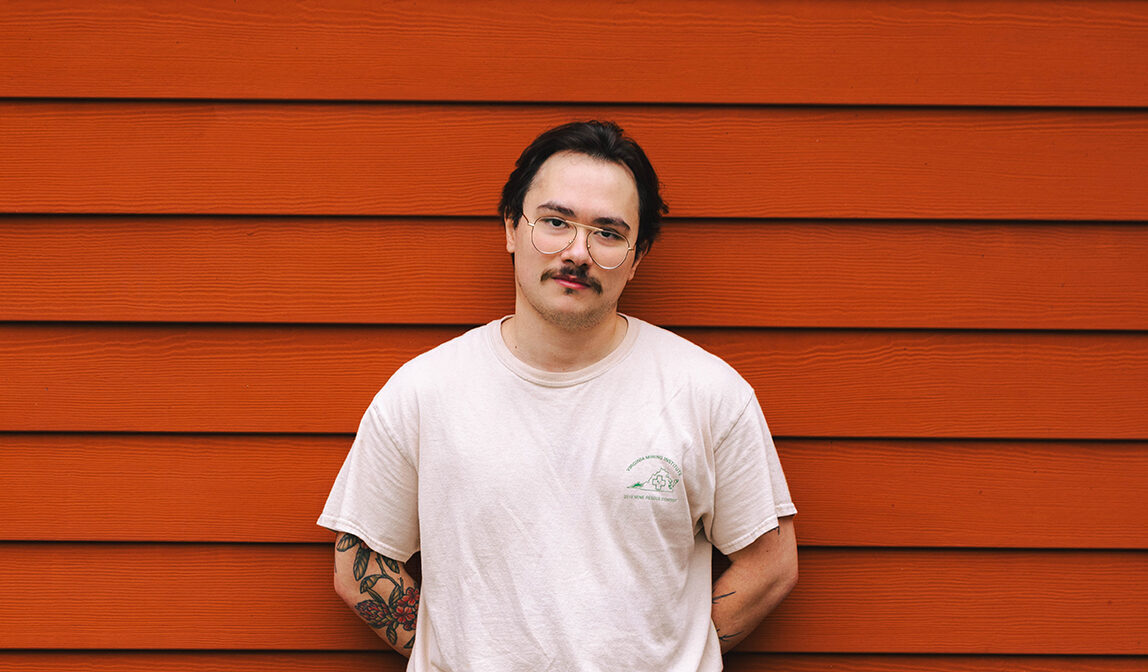

Antonio Vazquez Lim recounted growing up in West Virginia as relatively normal. It wasn’t until leaving to pursue his PhD at Miami University in Miami, OH, that he realized how Appalachia’s perception affected his entire core. Now, he hopes that by documenting it, he can preserve a rich history.
Antonio is a photographer, writer and collector from Charleston, WV, in Kanawha County, who focuses primarily on photographing regional architecture. Additionally, he is completing his PhD and recently received the National Science Foundation Graduate Research Fellowship, which is awarded to the most promising early-career scientists in the country and puts him in company with 50 Nobel laureates. He will be shifting into clinical psychology research about the presentation of mental illness, suicide and drug use from childhood trauma in relation to Appalachian culture, and how it affects young people here.
For example, he’s asking questions like: “How can mental healthcare professionals practice culturally-sensitive interventions in Appalachian communities facing vast opioid abuse?” or “How much Appalachian culture provides protective or risk factors moderating the relationship between childhood trauma and adolescent suicidality?”

He started pursuing photography when he left for his PhD in late 2024, and describes his passion as investigation of significance, examining objects and places that once held deep significance to West Virginians. With the hearts and minds of the folks here, Antonio said he is working to inspire change in West Virginia from historical, scientific/sociocultural and artistic angles, while finding the intersection between beauty and truth. His photography serves as “an attempt to humanize and learn from the past through personal effects and shared artifacts.”
“I’m not out to make poverty porn,” he said. “I know a lot of people do explore Appalachia and West Virginia for that purpose, and they can look remarkably similar to my pictures, but the goal is entirely different. I don’t want these communities to be forgotten, and I don’t want the evidence — the artifacts of these communities and the lives that the people there lived — to disappear.
To help with preservation, he also collects artifacts, like coal or company scrip and vintage bottles, which he describes as “old tokens.”
“They’re very utilitarian items, but they are deeply meaningful to me just because of who used them,” Antonio said. “These artifacts represent the labor of West Virginians, but they’re also evidence, in my eyes, to the injustices that the script system was.”
His favorite place to shoot is McDowell County, but anywhere in West Virginia south of Charleston is preferable, as documenting coal industry history is deeply important to him. Antonio feels privileged to be exploring communities people don’t often visit and being able to understand them.
“It makes you angry about what happened,” Antonio said. “I am a proponent of the interpretation that West Virginia, and central Appalachia as a whole, was industrially colonized by capitalists from wealthier urban areas. I call it domestic colonization — when they got our resources, then they left and they didn’t care what happened after. McDowell County is the ultimate example of that.”
Antonio said places like Gary, WV, are receiving some news coverage for their undrinkable water conditions and mentioned BowmanTV, an independent reporter covering injustices in West Virginia on social media. Despite their living conditions, he said the people he has met from the region are always unbelievably kind and willing to share.


One of his biggest challenges is actually ensuring the place he’s researched is actually still standing and documentable. He cited Charleston’s history of redlining, demolishing and urban renewal as reasons there are not more historic buildings today, like in Wheeling, WV.
Antonio says it’s best to focus on what West Virginia will become, but to know the history — the community, class consciousness and all of the things that brought people together. It’s also important to remember the dark side of West Virginia history.
“A lot of young people went directly into mines and never walked out,” Antonio said. “These companies treated us like mules and machinery. We don’t need any more massive corporations to come to our rescue.”
“We need opportunities, of course, but we need to understand that nobody is going to come to save us. They’re coming to exploit us. We really need to be the group who define our path as people, rather than as tools or mules for a mining company, labor to build their data center or any number of different things. We have to figure out how we can bring power back to ourselves, rather than export it to people in the Capitol building or to people looking to make a dime from us.”
Antonio feels passionately about issues directly affecting fellow West Virginians and will always call West Virginia home. When he left, he realized how typical Appalachian representation outside of the region puts individuals in a box. You can be the opposite of the “shoeless, toothless” stereotype and still be thought of as less than because of where you’re from.
He said growing up Filipino, Chinese, Hispanic and white in West Virginia was something that never made him feel different, and he never experienced overt discrimination. Antonio explained that his “white half” has been in West Virginia for generations, with ties to Beckley, Spencer, Parkersburg and Charleston, but his other family members likely immigrated in the 1940s or 1950s.
“I never really had to think about my identity growing up, it just felt like I was everybody else; every other person in Charleston, at least.”
While in Ohio, he felt like an enigma — being told by peers that he talks like someone from West Virginia, but doesn’t look the part.
“It really only started to sink in that I was not like America’s picture of a West Virginian when I went to college because of the way that I am, you know, being mixed,” Antonio said. “A lot of people are just very adamant that West Virginians have to be white and on drugs. I think that is one of the most horrific things that anybody could ever really believe about a group of people.”
Antonio is a critical thinker, empathetic, laid-back, knowledgeable and above all, passionate about what he believes in. It is because of this and his identity that he is able to understand intersectionality and the similarities between colonial and Appalachian oppression. Both colonial and Appalachian oppression completely suck the life out of an area— deprive the land, people and economy for ultimate profit to those in charge. Colonial oppression set the standard, but the intentional, derogatory stereotypes used to represent people in the Appalachian region helps keep outsiders uninterested in issues here, among other problems.
Antonio would not be researching and photographing the way he does if he had not had this proper foundation, being surrounded by the leftovers of a deteriorating coal industry.
“I can’t fathom anywhere else, other than West Virginia and Appalachia being my home, just because I know who I am here,” Antonio said.
His photography showcases the region and its history — creating bustling communities around a dying industry, just to watch the cities slowly sink back into the ground.
“I tend to consider these efforts as advocacy for West Virginia,” Antonio said. “Each demolished or collapsed company store is one more erased testament to the injustices wrought upon us. When I went to undergrad, people didn’t understand how West Virginia reached such dire circumstances. It was domestic colonization — my photographs of coal towns scream this truth.
My clear vision for West Virginia is the antithesis of our past, inspired from the past—it is an Eden where we, the people of our collective home, shape a destiny for ourselves not as mules, but as uniquely situated human beings with dignity. No more extracting our resources for out-of-state megacorporations. No data centers or tech companies. We, as West Virginians, must define our future that allows us to flourish. That does not imply growth — it implies a state wherein one can live safely and find a home without fear of reprisal for their identity. A state where we can drink our water. Where we are, for the first time, not subject to some higher corporate power.”
His upcoming work focuses on the tether between identity and place through portraiture. Looking at the immense spectrum of West Virginians, particularly those not represented in broader, American conceptions of “Appalachian.”

