
Suzan Ann Morgan may be Upshur County, West Virginia’s most dangerous woman. With some natural fiber fabric, fiber-reactive dye and a brain that loves to think critically, the newly 64-year-old has found a way to transform dedicated activism from her youth into creative expression.
As a fiber and textile artist, Suzan’s art — screenprinted, often politicized and always thought-provoking — has been recognized in art galleries and magazines throughout the region. This lifelong crafter has mastered (or at least attempted) nearly every artistic expression you can think to do with your hands and has settled on surface design.
“I suddenly realized, ‘Suzan, you’re getting older, you better just do exactly what you want.’ I just said, ‘Okay, I’m going to get out of the cooperative gallery, I’m going to make stuff that I hope falls into the art category more than the quilting gift category,’” she said about her artistic transition.
“It was a great leap; I was very much afraid. I thought, ‘You may totally fail, but you’re going to do it for yourself.’ I just started, and that’s what I’ve been doing ever since. It’s been working really well.”
Her art can range from pieces like “My Appalachia” — a hand-dyed, hand-embroidered, raw-edge appliquéd screenprint of a scene of rolling hills and forests, her own face laying in the middle, the earth and moon emerging from the back while literal angels and deer float in the fore- and background to “God Given Right”— a piece similarly created, but featuring a church complete with white pillars and a bright red interior. The Virgin Mary stands in the middle of machine guns with tree roots and stems growing out from both ends, seeming to hold up the church, foundationally. Little green army men and two girls in white church dresses stand on either side with lambs framing the bottom portion of the image.
Suzan pursued a psychology degree at Davis and Elkins College before transferring to the Oregon College of Art and Craft in the late 1990s. She studied surface design: the creation of art for products with a physical surface, including patterns and textures for items like textiles or wallpaper. It was here she developed skills like dyeing and printing on fabric, dyeing silk screens and making registration marks (crucial guides placed on screens to ensure different color layers align perfectly for multi-color prints).
“I thought, ‘Wouldn’t it be great if I could make my own fabric to make my own quilts?’” Suzan said. “So I went there for a year and I studied technique. I made one bed quilt and then never made another one. I just started making fabric and using it to make all kinds of things.”
After a year in Oregon, she returned to West Virginia, where she’s been since.
Born into a military family in 1961, Suzan moved frequently as she grew up. Along the way, she dreamed of being an artist.
Suzan credits Catholic nuns and her family upbringing as two of her biggest influences. Her Catholic background was full of contradictions — especially regarding killing and war — but she found fire within domestic “women’s” work, especially sewing and other traditional crafting. Suzan said she finds this sort of hands-on work incredibly empowering. She moved around, yes, but she also had to live with modest means. Without much, she learned to make most of her clothes herself. Putting these together, you get today’s Suzan: the base foundation of women’s work, plus the additions of advocacy, critical thinking and maybe even a little hippie nature.
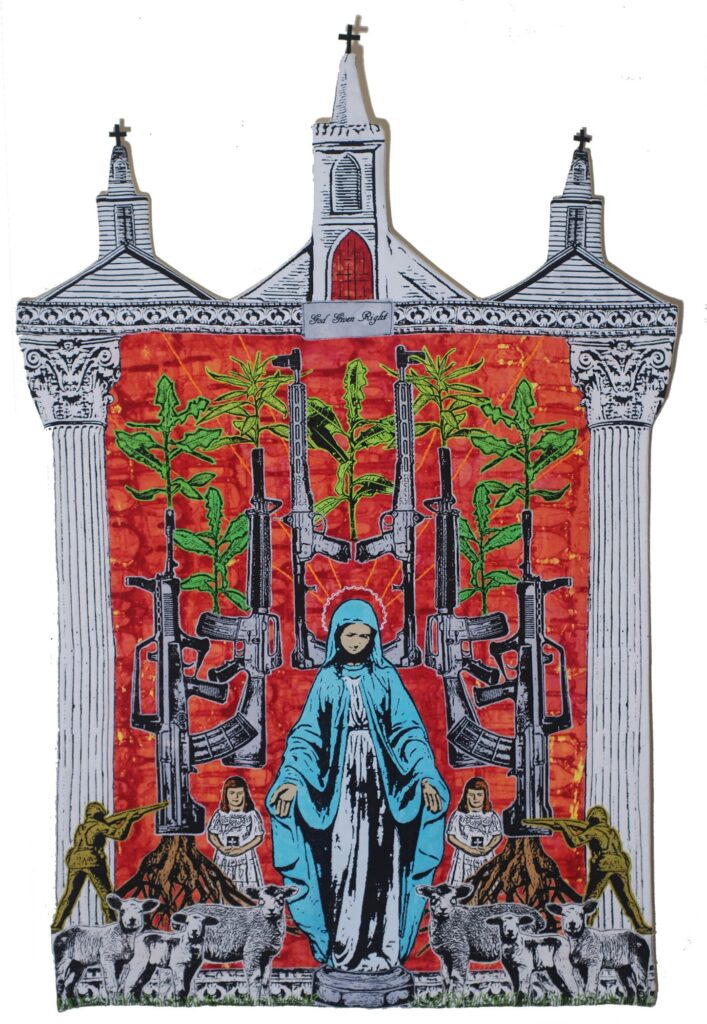
“I find myself further reflecting during the creation of each piece and, often to my dismay, I realize the contradictions and shortcomings of my personal beliefs. However, expressing myself through art provides me with temporary relief and furthers my investigation of our social world. I have the hope that you may identify with my imperfect truths,” Suzan said in her artist statement.
When she turned 18, she moved to an “extremely liberal and politically active” neighborhood in Baltimore, MD, where she was involved in all sorts of local organizations. It was during this period of her life that she was arrested at a die-in or lie-in protest for peace, a type of protest in which a group of people lie down in a public place as if they’re dead and refuse to leave or allow normal activities to continue there. Suzan and around 30 other activists laid, blocking the entrance to the Federal Building during Ronald Reagan’s presidency, while advocating against the SDI program, a plan to develop a space-based missile defense program.
“At that point, it was kind of a new idea, but Reagan and his folks were talking about the military in space, and we were just horrified,” Suzan said.
Her group made t-shirts that read “S.O.S, Save Outer Space” and planned to protest to gain time on the news in order to share their message.
“We sat on this area of steps, made some speeches, had a rally; it was very uncomfortable,” Suzan recounted. “The police came. Some of us refused to get up and were carried into the paddy wagon, into the police vehicles. I was one of those who refused to stand up. They took us to the Baltimore City Jail.”
After a night of mugshots, fingerprinting and sharing a cell with other activists, she was released — last, of course. The activists met up at the Methodist Church that hosted them, hopeful to be prosecuted, as a day in court would equal a chance to share their message on a televised news organization.
“So the next day, we were all like, ‘Yes, we want them to prosecute us, and we’ll get to speak in court. It’ll be on the news, and people will hear. Go peace!’ Yeah, well, the federal government is pretty smart, and they dropped all the charges, and that was it. We got on the news one night for having the die-in and we never had to have our day in court,” Suzan said.
After around five years in Baltimore, she was sent to West Virginia to work with an environmental group.
“As soon as I crossed the border, I was like, ‘That’s it. This is it,’” Suzan said. “I just knew I wanted to move here. I moved into Upshur County in 1988, where I am now and love it here. I’m never leaving.”
While she’s no longer the political activist she once was, Suzan has found a new way to advocate.
“This is now my way of making a statement — through art,” Suzan said.
Suzan draws inspiration from the world around her and forms the idea 90% in her head. She doesn’t use any sort of sketchbook; she simply visualizes in her mind what she wants to create.
“I don’t keep journals of any sort,” Suzan said. “I’m not a writer. I am not good with words. But, it’s like my journaling, it just takes a lot longer to do a page … I can’t help myself, not just because of the past many years of [Trump] being in office. Although that has just made it even more important to me, why I need to express myself. For me, personally, even if no one ever bought my work, I think I would still do it.”
The “page” takes an average of three 8 hour days a week, for three weeks, but Suzan said it varies piece to piece. She buys vintage linens, table cloths, tea towels and handkerchiefs — any natural fiber materials with any existing texture. She often dyes her own embroidery threads, quilting cotton and yarn.
“Everything, every piece of fabric you see, was white when I got it,” she said.
She first takes individual images (some her own photos, some borrowed), manipulates them in Photoshop and creates a silk screen with them. Then, the fabric is dyed, the image(s) are printed on top of the fabric and sewn together collage-style to make the project a whole piece. She adds images over top with more fabric, stitched on around the edge and then trimmed.
“I’m the kind of person that cannot work at more than one thing at a time,” Suzan said. “A lot of textile people have UFOs… unfinished objects. I can’t do it. I have to do one thing from beginning to end. I don’t want stuff sitting around that I can’t figure out what to do with later. If it bombs and I hate it, I throw it in the garbage. I just get rid of it. It doesn’t happen very often, but I’m just like, ‘Gone!’ I just get another idea in my head, and I go forward.”
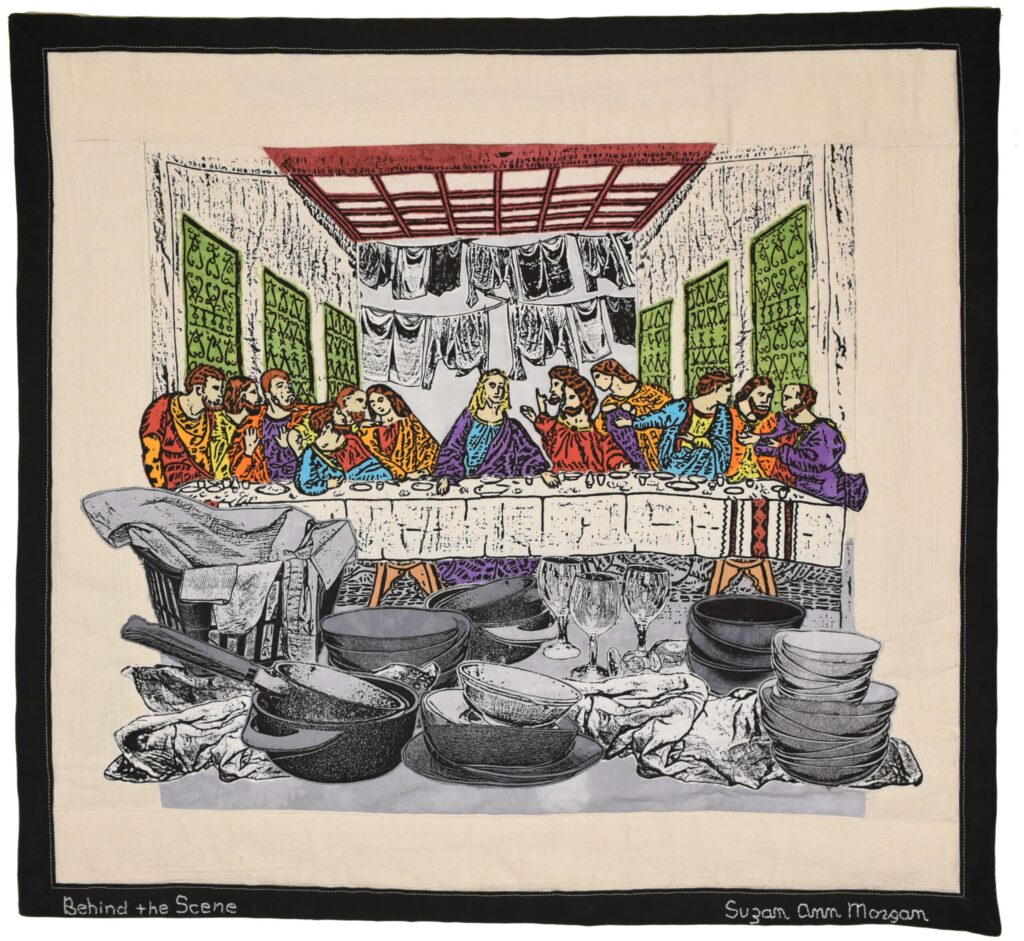
Suzan has been featured in high-end quilting publications like Art Quilt Quarterly, Art Quilting Studio,the West Virginia Vacation Guide and West Virginia Arts Works in 2021, 2023, 2024 and 2025. In 2023, she was selected as a 2023 West Virginia Juried Exhibition artist and won Best of Show, which included a $5,000 award.
She’s won various other awards, but winning $500 when she first decided to pursue art blew her away. Every time her art is recognized, she feels astonished, inspired and sometimes very self-critical.
“Every single time, I just can’t believe it,” Suzan said. “When I’m at shows, I see the other work and I’m blown away. I also have this horrible habit, when I see work that I really, really admire, I have a little feeling of ‘Is my work that good?’ I have self-doubt and I think, ‘No, it’s not.’ Or if I don’t get in a show, I’ve been rejected from tons of shows, I just get self-doubt. Maybe every artist does. But, then, of course, when it goes well, I feel very happy with myself and tell all my friends.”
“My goal right now is to find solo shows. The solo shows that I’ve done have sold work. I live in a small house, I can only keep so much. It has to go somewhere.”
Suzan’s art, while often political and controversial, tells stories anyone can pick up on. From a piece titled “fresh forest” an evergreen tree with green Little Trees air fresheners hanging off of several branches. The caption reads, “Now you know where fresh air comes from!”
This piece could be commentary on climate change, deforestation, over-consumption or all the above.
This type of art will make you think deeper whether you want to or not. It is how Suzan remains so dangerous. A dangerous brain will make you stop and reflect and learn. No matter how you feel politically, Suzan’s art can help you understand a different perspective you may never have considered.
Suzan tells her own truth, no matter how hard it may slap you in the face. She is humble, always willing to rethink and learn more and create freely. By doing this, she empowers others, whether she realizes it or not.
“I would like to think I could influence the world, which is probably not likely,” Suzan said. “I don’t know, but I’ve got to speak up. I’m not going to go into another Die-in for peace, but I am going to show my feelings and get it out there.”
To view Suzan’s work or to learn more, visit her website https://suzanannmorgan.com/.
