

From inside a greenhouse in Frankfort, KY, painter Ceirra Evans is talking about the future of her work, her life and the place that made her. It’s a future she envisions in vivid, lived-in detail: houses with solid roofs, families with enough to eat, creative paths that feel possible for kids growing up in the rural corners of the state. A future where Appalachia is not a relic or a stereotype, but a region in motion.
“I want this place to be housed, to be fed, to not have to suffer if it doesn’t want to,” she said. “And I want it to be a place people see as part of a modern narrative — not something stuck back in the 1800s.”
If you know her paintings, you know this future already exists on her canvases. Ceirra is a storyteller whose work insists that rural life belongs firmly in contemporary culture, in the conversations happening in galleries and museums, in national magazines and side-street folk festivals. Her scenes of family fights, creek-side lovers, cigarette-smoking babies and queer joy amid pickup-truck grit are not neat or nostalgic. They are, in her words, “claimed.” They are hers.
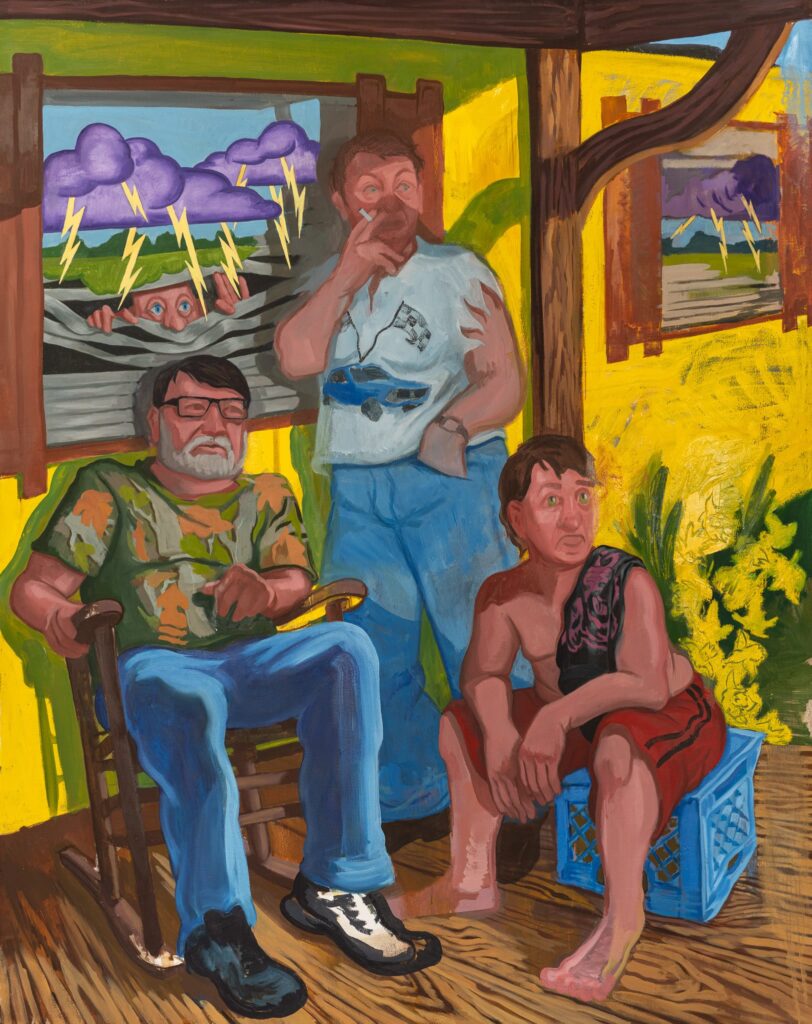
Born and raised in Bath County, KY, Ceirra has become one of the region’s most widely watched emerging painters. Her work has appeared in Hyperallergic, The New York Times and The New Yorker, the latter leading to an explosion of her work outside of Kentucky. When the article was published in 2022, Ceirra had folks reaching out to her from all over, sharing with her how much the work made them think of their homeplace in Appalachia. “Plenty of childhood stories were recounted,” she says.
She’s held solo shows from Louisville to Blacksburg to Paris. Still, she speaks of home with a mix of tenderness and challenge, the kind of clarity that comes only from belonging deeply to a place — and refusing to abandon it. “I love this place,” she said. “And I want to protect it.”
As a teenager, Ceirra was convinced that the only way to succeed was to escape. She applied exclusively to out-of-state colleges, convinced that the big city was the only valid start for someone serious about painting. She got into several top programs, including Rhode Island School of Design. But the financial reality hit hard.
“It was one of those eye-opening moments where I realized: ‘Oh, I really can’t afford this,’” she recalled. “And that was something a lot of kids like me — poor kids from Appalachia — are facing. But we feel just as talented and deserving.”
So she stayed in Kentucky, attending Spalding University in Louisville. The disappointment of not leaving later became a kind of gift; remaining in-state made her reckon with what rural belonging meant, especially as a young queer person stepping into adulthood. “Being around people who grew up differently than I did made me see how special the place I came from really was,” she said. “It made me a better queer person. It made me more empathetic.”
Louisville is not Appalachia, but it is Kentucky, and in its mix of community, contrast and creative peers, Ceirra began understanding her home as a subject worthy of art, not something to get away from, but something to look at squarely. Something layered and strange and beautiful, something she could claim.
In her early work, especially her first exhibition, Folklore, Ceirra painted Appalachia through a lens she once described as cynical. But revisiting those pieces now, she reframes that word. “I was just really butthurt that I couldn’t get out,” she said, laughing. “It wasn’t cynicism. It was hurt.”
One of the turning points was a painting called “Smoke Two To Shorten The Sentence,” a raw and intimate portrayal of her family. She almost didn’t include it in the show. “I was scared to paint it,” she admitted. “My mother, my brother, all of my family were in it.” But friends urged her to trust the work. The painting became the start of her career.
What followed was a slow but unmistakable shift from resentment to reclamation. Therapy helped. Time helped. Developing her artistic voice helped. “Once I got through all these expectations in my head, I started painting home through a lens of: no, I can claim this,” she said. “I can love it and critique it with a loving eye.”
Her canvases reflect that evolution — layered, emotional, sharp with humor and honesty. They are a record not only of what rural Appalachia is but what it feels like: contradictory, tender, full of grit.
Ceirra’s paintings have a visual signature, with exaggerated bodies that take up more space, emotions writ large, expressions leaning toward the cartoonish. What may look whimsical is actually strategy. “I get a lot of inspiration from cartoons,” she said. “Exaggeration helps the viewer understand the emotion, the story, the weight of it.”
In her queer-focused work, that exaggeration becomes another kind of reclamation. Ceirra is a butch woman painting butch bodies (her own and others) with dignity, affection and presence. “I make the hands bigger, the forearms bigger, the bodies larger,” she said. “Because I want them to take up space. I want them to feel monumental.”
Her visual influences range widely: painter Nicole Eisenman (“Finding her felt like finding someone who looked like me”), Kentucky folk artists like brothers Charley and Noah Kinney and musician Grace Rogers, a close friend. “Grace’s work is genius,” Ceirra said. “Her storytelling, her class consciousness, always inspires me.”
And then, there are the smoking babies.
Before the Appalachian narratives took full shape, Ceirra painted babies with cigarettes. Darkly funny, absurd and deeply personal. “I grew up around so much cigarette smoke, and I started smoking way too early,” she said. “The smoking babies were a way to exaggerate that memory, to connect humor and home.” It’s the through-line of her practice: the truth made sharper through irony.
She doesn’t shy away from painting addiction, both her own and her family’s. She will be three years sober this January, a milestone that intersects with her art in intimate ways. “Painting has held me when I couldn’t hold myself,” she said. “It’s helped me reclaim stories that are often told about us without us.” She paints the messy, complicated emotional archive of a rural life, from family fights, breakups, grief, queer desire, childhood memories, all of it. Humor helps soften it. Or perhaps, more accurately, humor helps reveal it.
“Adding humor makes the story feel like it’s mine,” she said. “It invites people in, even to the hard parts.”
In her view, it also reclaims Appalachia from outsider narratives that pathologize addiction and poverty while ignoring the systems and histories that shaped them. “I know it’s not the people’s fault,” she says. “So painting those stories from my perspective, that’s powerful.”
Ask Ceirra which misconceptions about Appalachia she most wants to dismantle, and she doesn’t hesitate. First: that people don’t want to work, or that people in Appalachia are not of the working class. “That’s absurd,” she said bluntly. “The one thing I hear from most people is that they are tired of working, not that they don’t work.” Second: that queer people are not made in Appalachia. “It’s such a frustrating idea,” she said. “I’m a queer butch woman from here. I know so many queer folks who grew up here. They’re proud of it.”
She spoke lovingly about rural masculinities, from her Papaw’s stories and her mother’s butchness (even though her mother is not a queer person) shaped her queerness in ways urban narratives rarely acknowledge. “I’m a better, more charming queer person because of where I’m from,” she said. “There’s a history here that gets overlooked.”
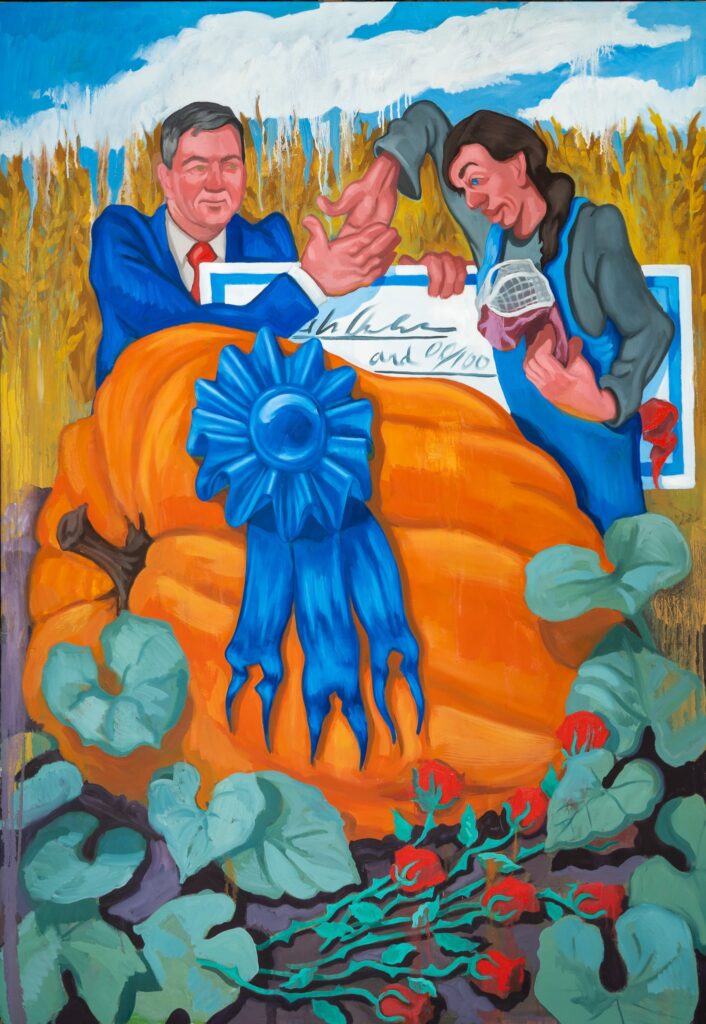
These layers of class, queerness, identity and place are always present in her work, whether explicitly or between the lines. “What I hope is that people see nuance,” she said. “That we aren’t all one thing.”
Ceirra speaks about creative solutions and how artists, by nature, imagine differently, collaboratively. She sees that as essential to the region’s future. “Creative solutions don’t come from one person,” she said. “They come from communities. That’s where artists can really do a lot of great work — being able to get together and organize.”
Her fiancé, a rural Kentuckian deeply involved in Appalachian-focused work, reminds her how collective that effort is. Their conversations fuel her belief that Appalachia’s future must be crafted locally, intentionally, with care. “Artists tell stories,” she said. “And right now, stories are being erased — by politicians, by climate disasters, by neglect. We have to keep telling them.”
Her work has circulated far beyond Kentucky, and the responses reflect a wide spectrum, from heartfelt connection to bewilderment to thinly veiled disdain. In Louisville, a tourist once glanced at her painting “In the Garden of the Lord” (a tender, creek-side portrait of two queer people) and spat out, “Aren’t they a bunch of rednecks?” Ceirra smiled and replied cheerfully, “Yes, they are.” In Paris, viewers couldn’t understand why a dog chasing a car down a country road was worthy of fine art. In New York, readers sent emails thanking her for depicting scenes that reminded them of their grandparents. When she paints herself into her work, she said, people sometimes insist she must be a boy. “They fight me on my own portrait,” she shook her head. “It’s wild.”
Even so, she believes Appalachian stories belong in national and international art spaces, loudly and proudly. “We have incredible artists here,” she said. “Just because people don’t see it doesn’t mean it’s not happening.” What she resists is the idea that recognition must come at the cost of the region’s integrity. “We don’t want a bunch of tourists ripping up the place,” she said. “We want people to be invited in, but respectfully.”
When she imagines Appalachia fifty years into the future, Ceirra returns to the tactile: hand-built fences, seeds in soil, the craft traditions that define the region. “In an era of AI,” she noted, “we need to keep valuing things made by hand.” Progress, to her, looks like more people becoming artists and more people being supported in the attempt. It looks like accountability for the region’s histories. It looks like space for everyone.
“There are people here of every shape, color, background,” she said. “Progress is acknowledging that and uplifting it.” And maybe most importantly, progress is the quieter internal shift she has learned to make: releasing the pressure, trusting the narrative, believing that telling your story is enough. “When we finally feel like we can commit to that,” she said, “that’s where the magic happens.”
After all the shows, the interviews, the travel, the critiques, Ceirra keeps one hope close: that people see the grit behind the work. Not the hardship, but the commitment. The effort. The labor of really telling a story. “I hope people see hard work,” she said. “I hope they see nuance. That we’re not all of one mindset. That we’re complicated.”
At home, Ceirra and her partner often talk about horseshoe theory: the idea that people aren’t as far apart as they seem. She thinks her work hints at that, the shared humanity, the overlap, the contradictions that make up rural life. “I hope people see that,” she said. “That these paintings aren’t pointing fingers. They’re making a stage.”
A stage for Appalachia — not as outsiders imagine it, but as it truly is. A region with pain and humor, beauty and frustration, grit and softness, contradictions and truth. A region worth painting loudly, lovingly and forward.
