

“Their music wasn’t about ego or money. They never charged a cent for a performance. It was all about praise.” That’s what Kelly Kerney told us about her Mamaw, Ella Hanshaw.
Ella (1934-2020) was an Appalachian artist who wrote hundreds of songs and considered her work to be sent by God. He’d “give” her a song (both lyrics and melody) which she’d write down and masterfully complete in fifteen minutes. As part of the Hallelujah Hill Quartet, Ella toured through West Virginia in the 1980s, but her music was never recorded professionally or released publicly until now.
Ella Hanshaw’s Black Book, lovingly compiled by her granddaughter from home and church tape recordings, is what Songlines Magazine calls one of the most anticipated releases of 2025. Ella was a unique talent with a singular voice, but that’s not all to her — her songwriting and self-documentation should be understood as part of a tradition of Appalachian women and mothers. On some of the unedited recordings, her children can be heard playing in the other room.
Sometimes, for Ella, the act of songwriting merged with the act of divine healing. Sick and struggling, she’d pray and work through a song. Once she completed it, the illness was conquered, and she’d be healed. The first track on the album, “One More Hill,” was composed this way after she suffered from ruptured and fused discs in her spine. “I hate to see you so sick,” her husband, Tracy, once told her. “But you always do come out of it with the prettiest songs.”
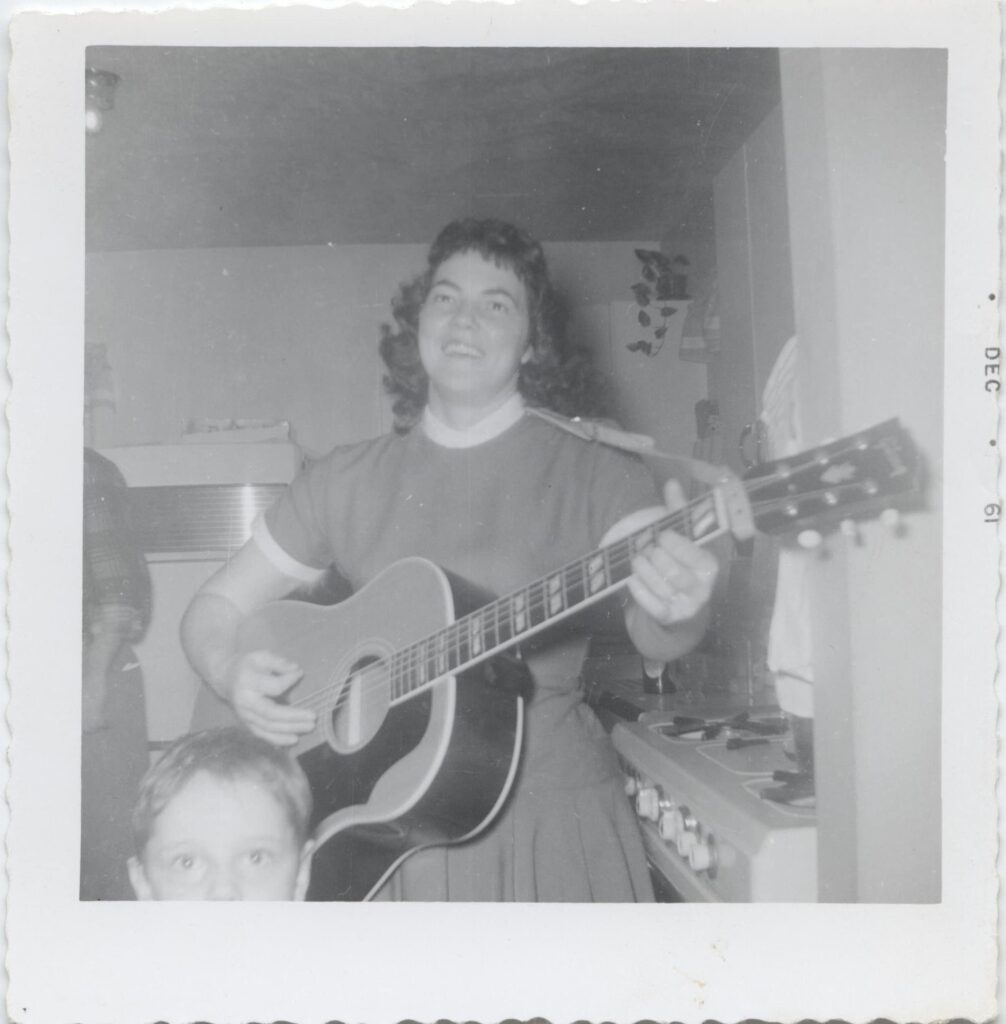
On June 3, 1991, Ella had her first vision. She spoke in tongues, a phenomenon described in the Bible as setting the faithful afire. If she had been smoldering with God’s influence before, now she felt fully aflame. Her transformative experience was considered blasphemous in the Baptist tradition, so she left the church she once helped build and became a Pentecostal. Her visions, which she recorded in more than one hundred notebooks, continued for the rest of her life. They reveal dark, astonishing scenes in which she took down enemies in epic battles. The lyrics of “Behold and Believe,” which draw from Luke 10:19 and feature serpents and scorpions, are an example of her dark and dramatic spiritual life seeping through her usually joyful tone.
Ella’s music is more than just earworms. In Appalachia, writing — recording family stories, inscribing birth and death dates in a Bible, maintaining correspondence or annotating cookbook recipes — was historically one of the few admissible creative outlets for women in the mountain South. By writing gospel music, performing in church, and viewing her artistic talent as gifts from God, Ella framed her work in such a way that she could still claim artistic agency while avoiding individual attention that may have been perceived as self-indulgent and socially unacceptable.
But now, things have changed, and Ella’s granddaughter has been hard at work. The process of bringing together the album was “…agony! For endless hours!” Because the original magnetic tapes are “notoriously unstable,” Kelley had to assume that she could only play a tape once before it might be destroyed.
“The long process involved a lot of frustration and suspense, but even more, we experienced constant surprise at the volume and variety of songs,” she said. “We ended up with 34 hours of music… We spent endless hours culling, choosing the best versions of the songs we wanted, and identifying tapes to try to get retransferred very delicately and professionally. A place called Red Amp in Richmond did that for us. Then Anna Frick, a sound engineer at Ally Sound, worked magic on the new beefy files…”
Despite noticeable differences between Kelley and her mamaw, their relationship with music connected them. Ella was a fervent Pentecostal, while Kelley had “a Master’s in English, a passport, and hadn’t considered [her]self a Christian since the age of 15.” Their values stood in opposition, but they were able to “reconnect… through the music. It became a shared passion.”
“Ella’s story of thwarted musical ambition refreshingly defies any simplistic interpretation,” Kelley said. While some might see a woman with no options in a sexist society, Kelley sees her grandmother as “a potted plant high up in the corner with… no natural light, thriving… And I think: this is a woman who shunned the path to fame in order to preserve the essence of pure praise in her music. In that, she was the ultimate, uncompromising artist. What’s more feminist than that?”

The themes that Ella wrote and sang about remain eternal: love and longing for what we can’t quite touch (not yet, anyway) and the physical pages of possibility that we can hold in the meantime. The Big Black Book and Little Black Book are guides left to us by a woman who smoldered steadily for decades until, one day in 1991, she woke up in flames — and from there confidently blazed her way into paradise.
Ella Hanshaw’s Black Book arrived June 13 on LP, CD and digital from SPINSTER.
