

Appalachia is frequently defined as what it’s “not just.” Often, not just poor, not just opioids, not just “country.” But this phenomenon begs the question of what Appalachia actually is, and the addition of the “just” implies that sure, there are those people — poor, rural addicts — but you wouldn’t really want to associate with them. Does their presence mean the region is any less deserving of dignity, introspection and care? A quick Google search yields “Another Appalachia,” “What You Are Getting Wrong About Appalachia,” “Rereading Appalachia” and a list titled “Books about Appalachia that are not Hillbilly Elegy.”
But defining Appalachia by what it isn’t is a new kind of fetishism that can border on infantilization — Appalachian people just love crafts and eating biscuits and telling stories! In the post-Hillbilly Elegy paradigm of Appalachia, culture has yet to really find a way to talk about the region without some sort of patronizing gloss on it.
Art can be a way to understand nuance within a place. Griffin Nordstrom’s group exhibition, Our Appalachia, staged at Brew House Arts in Pittsburgh, PA, highlights the Solar Ant Arts Collective, a group of working artists based out of Elkins, WV. In the title, Griffin doesn’t lead with a negative. Instead, he claims it for the artists.
A show like Our Appalachia faces the challenge of finding some essential, shared character in the works beyond just their geography. Many different kinds of people live in Appalachia, making many different kinds of artwork.
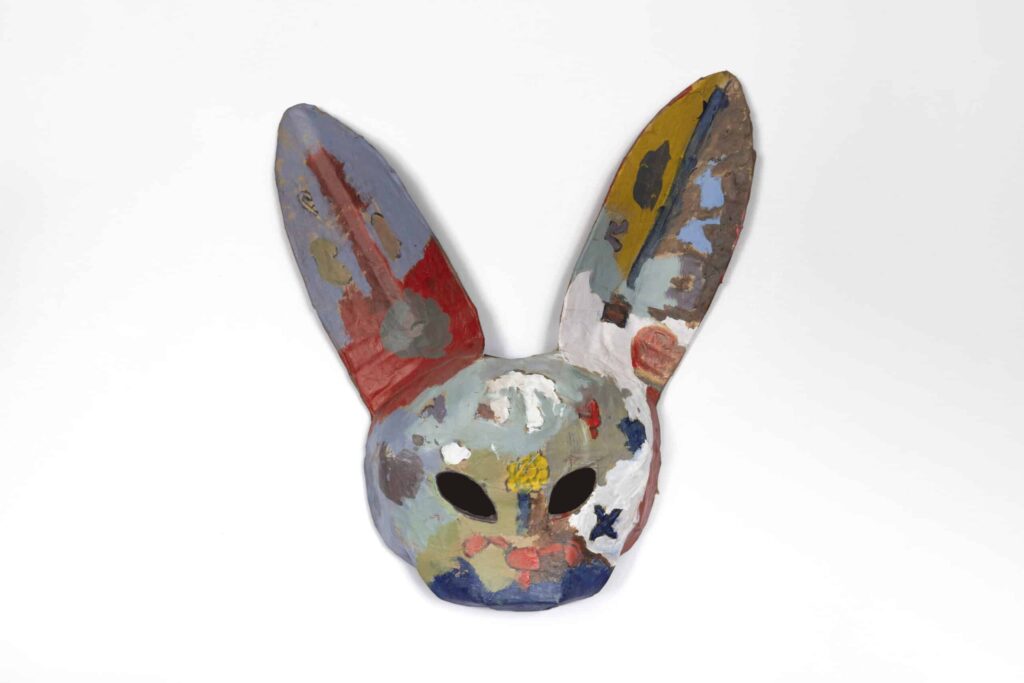
“There’s a significance of place in this work,” Griffin explained. “But also, thinking about Appalachia as welcoming. People have this idea of Appalachia as welcoming, but only to a certain kind of person.” He noted that many artists in the show are open members of the LGBTQ+ community, and Elkins recently passed a fairness ordinance legislating against discrimination.
Saying works of art have “place” as a theme is one of those art-speak terms that many use and few actually examine. But for Appalachian art, when the geography is so tied up in outsiders’ ideas of it rather than a literal reality, place (the land and its offerings) is one of the few real, concrete things the work can ground itself in. The works in Our Appalachia aren’t exactly installations, but they create an environment and place.
“There’s a big theme of the environment in the work,” he said. “Nature comes up with both natural materials and talking about the environment with non-natural materials.” However, lest he be painted as some sort of nature guru communing with the forest gods, he added: “I’m the least outdoorsy person in the world. I don’t camp, don’t fish, don’t hunt, even though I’ve had a fishing and hunting license my entire life through my dad.”
The show welcomes people into the space using a reconstruction of Nevada Tribble’s living room, where the Solar Ant Arts Collective meets. Brew House Arts is a massive space, and every show it hosts has to find a way to make use of it. Our Appalachia fills it organically. Gallerygoers moved through the show with ease and gathered around Domenica Queen’s “Gingko Tree Incarnation,” a wire mesh “tree” with leaves made of plastic bags. People further gathered in Nevada Tribble’s “Bail the Ocean, Bail the Sea: Square Dance Caller’s Notes,” which places vinyl diagrams on the floor mimicking a square dance pattern.
Our Appalachia leans into folk traditions like textiles, but it also asks the question of why this type of work is considered craft and not fine art. To me, the show’s standout was painter Wilhelmina McWhorter’s two works, “Dantesque” and “Lucky You.” Wilhelmina is one of those artists who looks like their art, the balance of unapologetic-ness and subtlety in her paintings also conveyed in the way she carries herself.
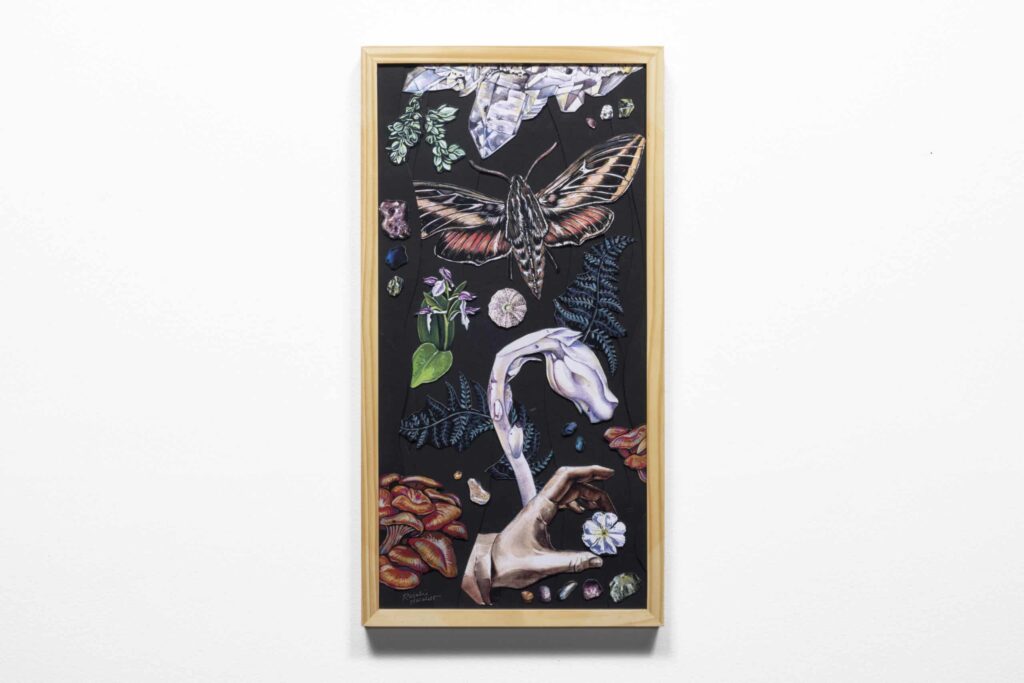
“I look at shadows as space rather than places without light,” she said. In her paintings, shadows seem to dance and undulate. The figures in “Dantesque” blur and become almost animalistic, pairing with the supernatural and uncanny masks from the Fasnacht festival in Helvetia, WV, by Aira and Corrina Loren. Wilhelmina’s “Lucky You”is a mesmerizing piece that I felt got at something essential about Our Appalachia, though it’s a portrait without direct ties to Appalachian culture and history. The painting is a striking image of a woman from below, her eyes looking somewhere away from you, her hair illuminated in fluorescent pink. It brings to mind Stacy Kranitz’s photographs of women, claiming female sexuality while not appearing sexualized.
“The painting is based on a photo of my friend who had a tattoo on her pubic bone saying ‘lucky you’ for whoever got to bed her,” Wilhelmina said. “I love portraits for the same reason I love street photography. People can be dismissed as normal, but you catch them in a rêverie and they show that to you.”
Living and working in Appalachia as an outsider has challenged me and shaped me for the better. I grew up in New York City, albeit in a working class, multiracial community that is a side of New York few outsiders engage with. I can relate to feeling that one’s home is misunderstood and twisted into a one-note talking point rather than a real place with real people in it. Appalachia is a place with poverty and suffering in it — just as many other places have, too — and denying that truth is an oversimplification. But one of the central tenets of Appalachian culture is to respond to times of suffering with care. More than any other region in the United States, Appalachia has a culture of hospitality, even when people have very little. That hospitality builds toughness that gets people through difficult times. Like the weaving works in Our Appalachia, the region is a tapestry, with frayed ends and rips and tears in it, but also a profound ability for repair. At times it’s messy, but as the title of the show suggests, it’s ours.
