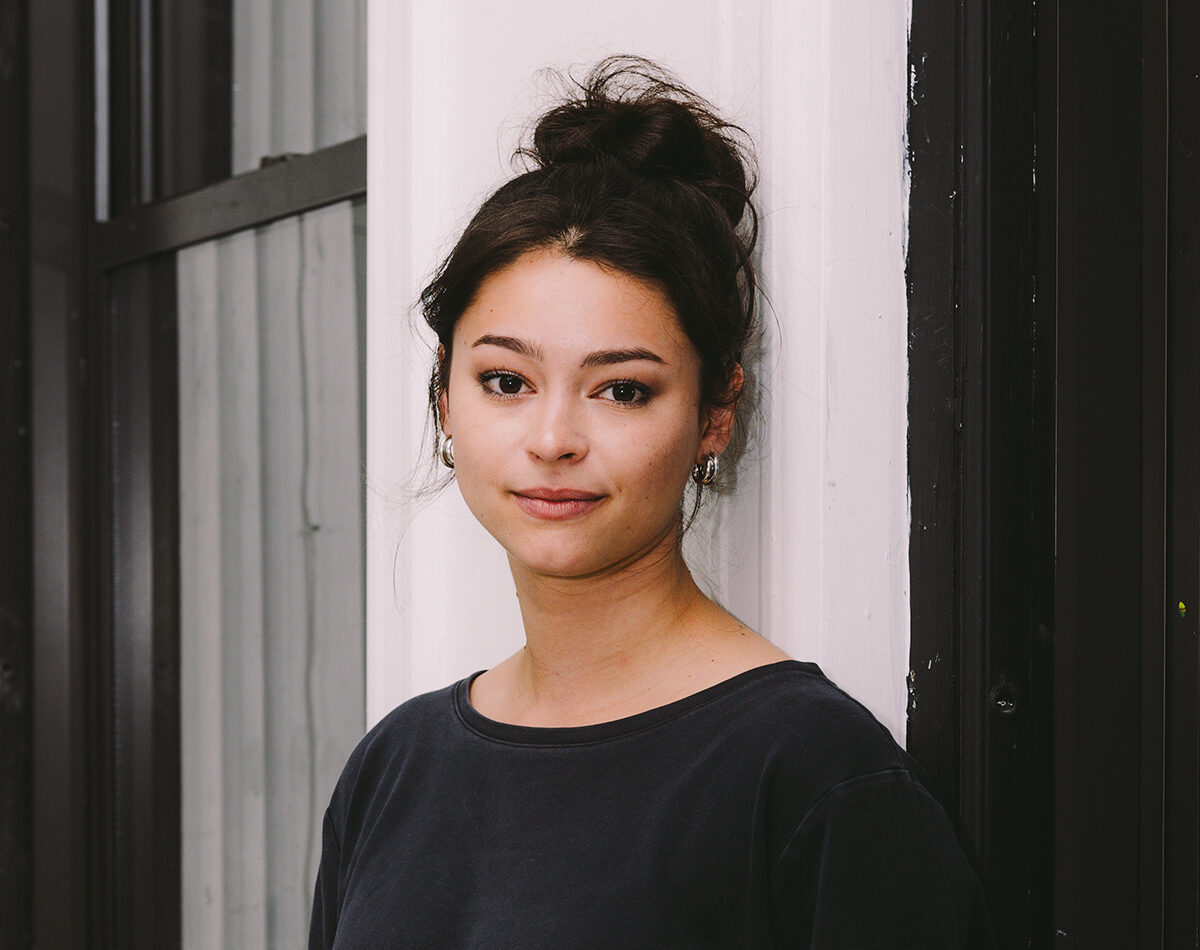

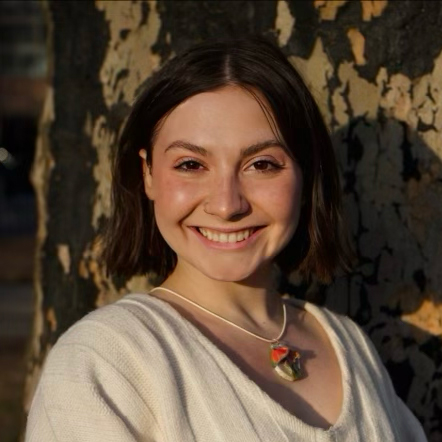
Abby Masel’s work is defined by duality. She straddles the worlds of art and science in a way that is both admirable and uniquely her own, finding a foothold in each and using one to fuel the other. Thousands of data points on a map or a web of geographic information can ignite the spark of her creativity. Her work is both geometric and surreal, and the themes she explores are equally complex — moody yet playful, often delving into darker concepts through bright, energetic colors.
She seems to find inspiration wherever two differing worlds meet, bringing those contrasts together in a way that feels entirely her own. That sense of duality extends to the natural world, which has played a central role in shaping her artistic vision.
Abby said, “It’s a very unique place to live, and I don’t know anywhere else in the world that is like Appalachia.” She describes Charleston as a safe haven, a place where she’s been able to find footing and reroot, build a home, experience stillness and most importantly, it’s a place chock-full of inspiration.
The landscape, wildlife and traditions of the region have become embedded in her artistic practice. “Appalachia is filled with mesmerizing plants and animals that can almost feel otherworldly at times,” she said.
Abby is a multidisciplinary artist whose creations span painting, drawing and mixed-media watercolor. Her work is rooted in the natural world, with birds holding a particularly special place among the insects, flowers and everyday wonders of West Virginia’s ecosystem that inspire her.
Lately, though, she’s been looking at nature from a little further away.
Outside of her work as an artist, Abby is a spatial analyst specializing in Geographic Information Systems (GIS). “It’s interesting because data can actually be really pretty,” Abby said. “There’ll be thousands and thousands of points, or just layers of different pictures of a map, and it can look like a mosaic.”
Her background in science has followed her into the studio, where the way she analyzes information has begun to shape the way she creates. By marrying those two sides of herself, she has found a way to see the artistic potential in the technical.
That duality can be seen in some of her newer work, where translucent circles and squares are layered across the canvas. Sometimes these shapes are meant to reveal a pattern or evoke a feeling; other times, they exist because Abby likes what they add to the piece. She said, “Sometimes they simply are just pretty to me.”
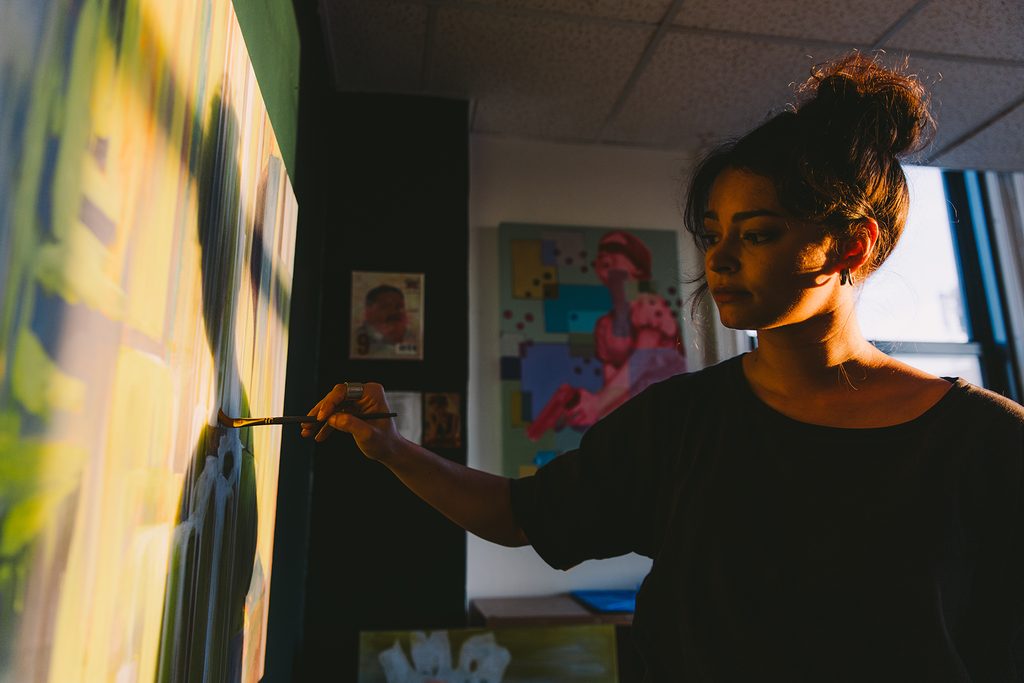
One of her newest pieces, “The Girl With The Gun,” is an example of this geometric layering, but the use of circles and squares goes much deeper here. Depicting a blindfolded little girl, holding a gun in an array of vibrant, lively colors, her innocence feels palpable even though the subject matter is dark.
Abby sees two meanings in the painting. The first is a reflection of a child’s inability to fully understand the impact and complexity of school shootings in America. Each dot represents a peer and each block represents a classroom, turning the geometric shapes into something much more human.
The second meaning draws on the symbolism of Lady Justice, who is traditionally blindfolded and meant to represent impartiality and truth. Here, she is young and naive; instead of holding the weight of the scales of justice, she holds the weight of a gun to compensate.
Abby said, “Although these points may take a somber tone, it was so much fun creating this piece and my hope is to incorporate this playful style in more of my work.”
Her environmental science background also shapes the themes and emotions that are a throughline in her paintings. She’s interested in the balance between life and death and everything in between, which can infuse her paintings with a range of moods, from gloomy and unsettling to bright and playful.
Abby is drawn to “dark and disturbing” media for its surreal qualities, but her own work often takes on a much more colorful approach. She sees that duality as a “signal of maturity” in her practice, allowing moody ideas to exist alongside vibrant colors and whimsical imagery.
Lately, she’s been experimenting with color, patterns and layering to create compositions that feel both strange and charming.
“Sometimes I just paint what I feel like at the time,” Abby said. “If I’m feeling down, I’m probably gonna use moodier colors; if I’m feeling happy, I’m probably gonna use brighter colors.”
As a predominantly self-taught artist, Abby feels like she has the freedom to experiment.
“Honestly, I thought being a true artist meant you had all the pedigrees of success: being in galleries, having awards and a recognizable last name,” Abby said. “But in reality, since the moment I could pick up a pencil or paintbrush, I became an artist.”
Abby comes from a family of makers. “Visual art is just something I’ve always naturally gravitated towards since a young age,” she said. Her great-grandfather was a woodworker, as is her mother, while cousins, aunts and other family members have all found their own creative outlets as painters, musicians, collectors and textile artists.
When it came time to make decisions about college, Abby leaned on that family of artists. Though they encouraged her to pursue science, she knew they would support her artistic endeavors, too.
“Artists and Appalachians are such resourceful and resilient people, so if there’s a will, there’s a way, and I pursued both,” Abby said.
While earning her degree in environmental science at Shepherd University, Abby figured out how to pursue art in the classroom, too. She approached the professor of an art class specifically for art majors, showed some samples of her work and made her case. The professor made an exception and allowed Abby to take the class, giving her the opportunity to learn some of the foundational principles of art in an academic setting.
Abby charts her own path, making space for herself wherever she finds the opportunity, shifting between the worlds of art and science, navigating the assumptions that come with each while finding her own place in both, as well as what it means to be an artist in West Virginia.
“I think West Virginia has such a stigma attached to it,” Abby said. “One that I fed into when I was younger.”
The longer she’s lived in the state, though, the more she’s come to appreciate the things that make it unique. For Abby, part of pushing back against that stigma means keeping the traditions of the region alive.
Canning, quilting and gardening are all traditions woven into Abby’s life in West Virginia, as well as pieces of her heritage that she wants to preserve. “Don’t let go of what makes us unique,” Abby said. That also means supporting the artists who are already here.
Her own roots have grown deeper the longer she’s stayed in the state.
Abby is a member of HACKS, the Huntington Artists Collective and Studios, an eclectic artist group based in Huntington whose goal is to foster the arts in the region and uplift marginalized voices.
Through HACKS, Abby has a studio space and a community of artists. She’s found a group of people who share resources, encourage each other, make each other laugh and push one another creatively.
Abby recently completed her largest painting yet with Echo-Lit, a new printing shop in Charleston. Echo-Lit partnered with Marigold Creative Reuse Co. through the West Virginia Creative Network’s Ripple Program, which connects working artists with local businesses to create community art installations and transform public spaces.
And now, in a collaboration with Charleston Public Art, she’sworking on a new butterfly-themed mural as part of the city’s beautification efforts.
And she’s not slowing down anytime soon. “I’m in my sponge era,” Abby said. Rather than planning every step of her career, Abby wants to stay open to new ideas, mediums and opportunities. For now, she’s working on refining her signature style, bringing that duality to life, while meeting more artists throughout Appalachia, across the country and even internationally.
She recently returned from a trip to Iceland, where she was surprised by how familiar the country felt. ItThe landscape, colors, textures and sense of magic reminded her of home.
In February 2027, she hopes to turn that experience into an interactive solo show, creating something that captures what she discovered.
For all the places Abby has been, she doesn’t seem to be leaving West Virginia anytime soon.
“West Virginia is severely underrated,” Abby said. “We are cooler than we’re given credit for.”
The longer Abby stays, the more she finds to appreciate about the place she now calls home. The art, the traditions, the people, the landscape and all of the unexpected things there are to discover have given her plenty of inspiration to work with.
“Hidden gems are the most valuable and desired,” Abby said. For Abby, West Virginia is one of those hidden gems, and its influence on her art is still unfolding.
This series is presented by Oglebay Institute and supported by the Greater Kanawha Valley Foundation’s Narrative Change Collaborative.
